


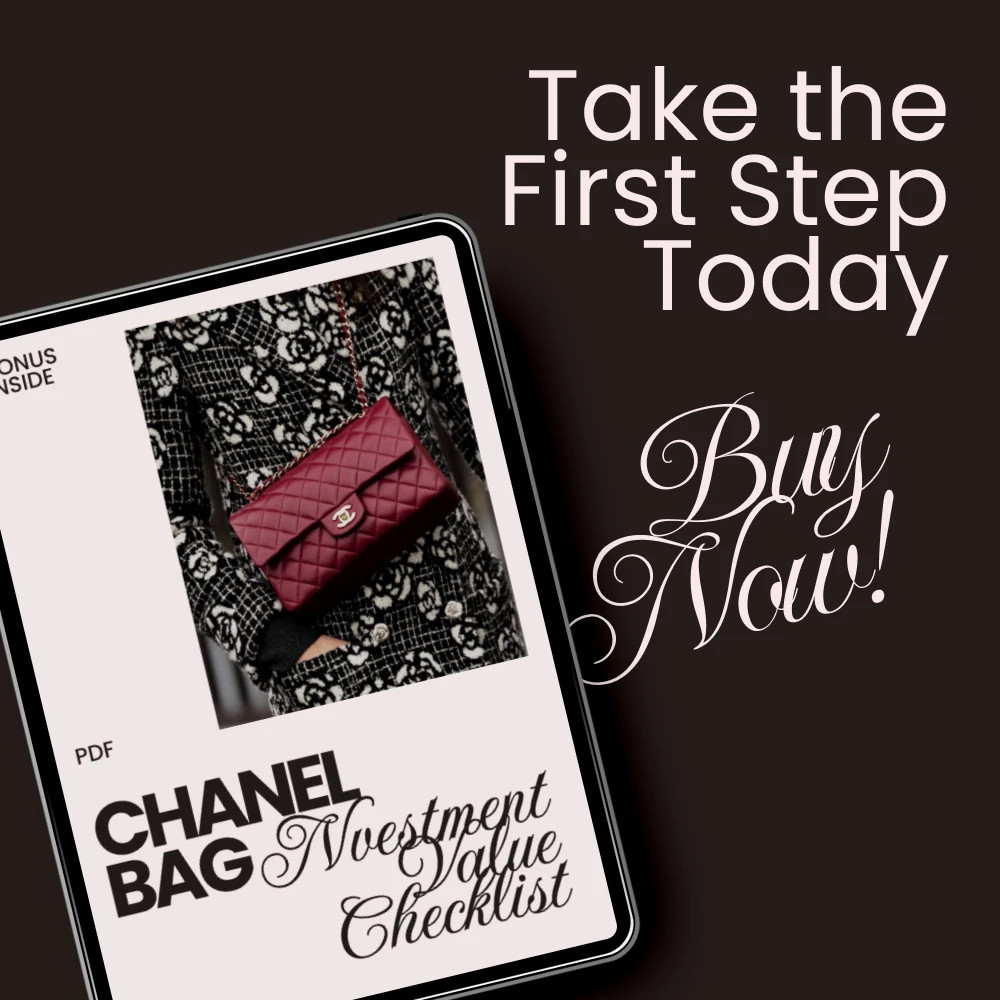
Unlock the True Value of Your Chanel Bag Investment
Investing in a Chanel bag is more than just owning a piece of luxury fashion — it’s about securing a timeless asset that can appreciate in value over time. Our Chanel Bag Investment Value Checklist is a must-have guide for anyone looking to make a smart purchase. Whether you’re new to luxury bags or a seasoned collector, this easy-to-follow checklist will help you evaluate the true investment potential of your next Chanel piece. Make informed decisions with our expert tips, and ensure that your Chanel purchase remains a valuable asset for years to come.
Key Features of the Chanel Bag Investment Value Checklist
- A comprehensive guide to identifying investment-worthy Chanel bags
- Detailed advice on the best Chanel models for long-term value retention
- Tips on selecting the right materials and hardware for resale success
- Exclusive insight into Chanel’s price increase strategy and resale market trends
- Practical tips on maintaining and storing your Chanel bag to preserve value
- Helpful recommendations on whether to buy new or pre-owned
Why This Checklist Is a Must-Have
The Chanel Bag Investment Value Checklist is designed for those who are serious about investing in Chanel bags and want to maximize the return on their investment. Whether you’re shopping for your first Chanel bag or expanding your collection, this digital guide provides practical, easy-to-understand advice tailored to your needs.
What makes this checklist stand out from other resources? It’s the perfect blend of expert knowledge and actionable tips. You won’t just learn which bags are likely to hold or increase in value, but you’ll also receive essential maintenance advice to ensure your investment is protected. This checklist gives you the edge when it comes to making decisions in a crowded, sometimes overwhelming resale market.
Practical Benefits
- Identify high-value models: Understand which Chanel bags appreciate in value, like the Classic Flap, 2.55 Reissue, and Boy Bag.
- Choose the right materials: Learn which leathers and skins hold value the best, including caviar and lambskin.
- Maintain pristine condition: Keep your Chanel bag in top shape with our expert care and storage tips.
- Maximize resale potential: Follow our resale market trends to make smart purchasing decisions.
- Buy smarter: Whether buying new or pre-owned, get expert advice on getting the best deal with long-term value in mind.
Start Investing in Fashion Today
If you’re ready to secure a valuable piece of fashion history, the Chanel Bag Investment Value Checklist is your ultimate guide. Don’t make a purchase without the insider knowledge that can help you make the most out of your investment. Download now and make sure your next Chanel bag purchase is a smart one!
Order cancellation
All orders can be cancelled until they are shipped. If your order has been paid and you need to make a change or cancel an order, you must contact us within 12 hours. Once the packaging and shipping process has started, it can no longer be cancelled.
Refunds
Your satisfaction is our #1 priority. Therefore, you can request a refund or reshipment for ordered products if:
- If you did not receive the product within the guaranteed time( 45 days not including 2-5 day processing) you can request a refund or a reshipment.
- If you received the wrong item you can request a refund or a reshipment.
- If you do not want the product you’ve received you may request a refund but you must return the item at your expense and the item must be unused.
We do not issue the refund if:
- Your order did not arrive due to factors within your control (i.e. providing the wrong shipping address)
- Your order did not arrive due to exceptional circumstances outside the control of legendarypicksmarket.shop (i.e. not cleared by customs, delayed by a natural disaster).
- Other exceptional circumstances outside the control of https://legendarypicksmarket.shop
*You can submit refund requests within 15 days after the guaranteed period for delivery (45 days) has expired. You can do it by sending a message on Contact Us page
If you are approved for a refund, then your refund will be processed, and a credit will automatically be applied to your credit card or original method of payment, within 14 days.
Exchanges
If for any reason you would like to exchange your product, perhaps for a different size in clothing. You must contact us first and we will guide you through the steps.
Please do not send your purchase back to us unless we authorise you to do so.
Instant download
Your purchase will be available to download once payment is confirmed.
Instant download items don’t accept returns, exchanges or cancellations. Please contact us if you have any problems








The caviar vs. lambskin breakdown alone saved me from an expensive resale mistake.
✨
The price increase section reframes everything — understanding that retail hikes pull resale values upward completely changed how I think about timing a purchase I'd been waiting for prices to stabilize, which means I'd been waiting forever. This is the first guide that explained the logic clearly enough to stop hesitating.
Never realized serial numbers and an authenticity card could affect resale price this significantly.
I've been collecting for six years and still found things in this checklist I hadn't formalized into a proper framework. The hardware guidance — sticking to classic gold-tone or silver and avoiding trendy finishes — is something I learned the hard way after selling a limited-edition piece that sat on the market for months when it should have moved quickly. The model selection breakdown between the Classic Flap, 2.55 Reissue, and Boy Bag is accurate and clear, especially the note that not all Chanel bags appreciate equally. The condition care points — storing upright, avoiding humidity, no overfilling — are things I tell every new buyer I know, and it's useful to see them framed as a pre-purchase checklist rather than an afterthought. Compact but serious.
Slow-burn investment, not a quick flip — that framing alone is worth downloading this
Accurate on all the core investment principles — model selection, material durability, and the connection between Chanel's retail price increases and what follows in the secondary market. The condition and storage section is practical and something new buyers consistently overlook. One missing piece: the guide doesn't address how to evaluate pre-owned condition beyond checking documentation, which is where most purchasing decisions actually get complicated.
The 5–10 year minimum hold recommendation resets expectations in exactly the right direction.
I bought my first Chanel — a lambskin Classic Flap in black with gold hardware — three years before I understood anything about investment value. I chose it because I loved it, which isn't a bad reason, but I had no framework for why one model outperforms another, why hardware finish affects resale, or why keeping the original box and dust bag matters beyond aesthetics. Finding this checklist before a second purchase changed my entire approach. The material section clarified something I'd sensed but never confirmed: caviar leather commands stronger resale because condition is easier to maintain over years of use, while lambskin, which I genuinely prefer aesthetically, requires more deliberate care and shows wear more visibly in the resale market. I now store both bags upright in dust bags in a humidity-controlled space rather than stacked on a shelf corner, which had been my habit without thinking. The retail price increase section was the most eye-opening point — I hadn't connected Chanel's consistent pricing strategy to the behavior of the secondary market, but once that logic clicks, the long-term hold advice makes complete sense. I had been watching resale prices on discontinued colors without understanding why certain colorways spike, and now I track limited-edition premiums as a separate category rather than lumping them in with classic styles. The new vs. pre-owned section is also useful for a buyer considering entry through resale — the ROI framing around excellent-condition pre-owned pieces demystified something I'd found confusing. Before this checklist I was buying emotionally with no investment structure. After reading it, I bought a medium Classic Flap in black caviar with silver hardware — both material and hardware chosen deliberately — and I plan to hold it through at least two more Chanel price cycles.
The distinction between caviar and lambskin from a resale standpoint is something I'd never seen laid out this clearly Lambskin is beautiful but caviar is the smarter long-term play for condition retention — and this checklist explains exactly why buyers in the secondary market respond differently to each. Practical and precise.
Everything checks out — wish there was more guidance on spotting condition issues in pre-owned pieces.
The point about discontinued colors and seasonal collections becoming premium resale items is something active collectors know but beginner guides rarely surface. This one does it concisely, and the guidance to track both resale platforms and auction results gives new buyers a real methodology rather than vague advice. The 2.55 Reissue framing is also solid — most introductions to Chanel investment blur it together with the Classic Flap without explaining the separate collector dynamics.
✅
Three purchases in, and I'm only now building a real investment framework — this checklist would have changed my first two decisions significantly. The model guidance is exactly right: Classic Flap and 2.55 Reissue consistently outperform seasonal and limited styles in resale, and understanding why requires market context rather than brand enthusiasm. The hardware section clicked in a specific way — I'd been drawn to newer finishes and didn't understand that classic gold-tone and silver aren't just conservative aesthetic choices, they're liquidity choices. The condition section formalizes what proper stewardship actually means: upright storage, humidity control, no overfilling, professional cleaning rather than DIY treatment. I've shared these notes with two friends preparing for their first purchase, and both said the same thing — they'd assumed the bag itself was the whole decision and had no idea that material, hardware, documentation, and storage habits were all part of a single investment thesis.
The framework is sound — model hierarchy, material durability, hardware longevity, the price increase strategy — and the resale market section gives useful context on discontinued colors and limited-edition premiums. What's missing is any meaningful guidance on how to actually verify authenticity beyond noting that documentation matters, which is the most consequential skill for anyone purchasing pre-owned. The bonus business offer at the end also felt inconsistent with an otherwise focused investment document.
Documentation isn't an afterthought — it's part of the asset ️
The retail price increase strategy section is underrated content — most buyers experience Chanel's pricing hikes as frustrating news rather than thinking through what they mean for secondary market behavior. Once you understand that retail increases pull resale prices upward, model choice and timing start working together as a deliberate strategy. The slow-burn framing at the end ties this logic together cleanly.
Avoided a Boy Bag in a seasonal colorway after reading the neutral-tone investment tip.
Accurate on all the fundamentals — could go deeper on which specific resale platforms are worth tracking.
A resale specialist told me last year that condition documentation is as important as the bag itself for commanding top prices, and this checklist confirms that framework precisely The serial number, authenticity card, original box, and dust bag aren't accessories to the purchase — they're components of the asset. What I appreciated is how the storage guidance connects directly to eventual resale: storing upright, keeping away from humidity, and avoiding overfilling aren't just about maintaining appearance, they're about protecting a price ceiling. The model hierarchy — Classic Flap first, then 2.55 Reissue, then Boy Bag — is consistent with everything I've seen on the secondary market, and the neutral-colors-outperform-seasonal point is something I now apply at every purchase decision.
Five-to-ten year minimum hold — finally a guide that treats this like the investment it actually is.
✨
The core eight-point structure is well-organized and applies equally to first-time buyers and those building a wider collection. The material section is the strongest — the caviar durability argument for long-term resale performance is clearly made and grounded in how condition affects secondary market pricing. Four stars rather than five because the guide doesn't address authentication resources or practical differences between resale platforms, both of which matter to any buyer acting on this advice.
The note about exotic skins carrying fluctuating demand is a nuance most buyers miss — rarity alone doesn't guarantee appreciation ✨ Pairing that caveat with the consistent performance of caviar leather in neutral colors gives a clear preference hierarchy that is immediately actionable. Everything here is structured around investment logic rather than brand admiration, which is exactly the right framing.
What makes this checklist stand apart from general luxury guides is the investment logic threaded through every section — it doesn't just describe what to buy, it explains why specific choices outperform others in the secondary market over time. The model selection section, for instance, doesn't just name the Classic Flap, 2.55 Reissue, and Boy Bag — it positions them within resale demand, which helps a buyer understand what they're actually choosing between. The material section applies the same thinking: caviar's durability advantage isn't cosmetic, it directly affects condition ratings that determine resale pricing years later. The hardware framing is particularly sharp — classic gold-tone and silver as liquidity choices rather than aesthetic preferences is a distinction experienced collectors understand and beginners almost never hear articulated. The long-term hold section brings everything together: Chanel bags reward patience and deliberate maintenance, not urgency or trend-chasing.
Useful starting framework, but the authentication guidance is far too thin for a pre-owned investment guide.