



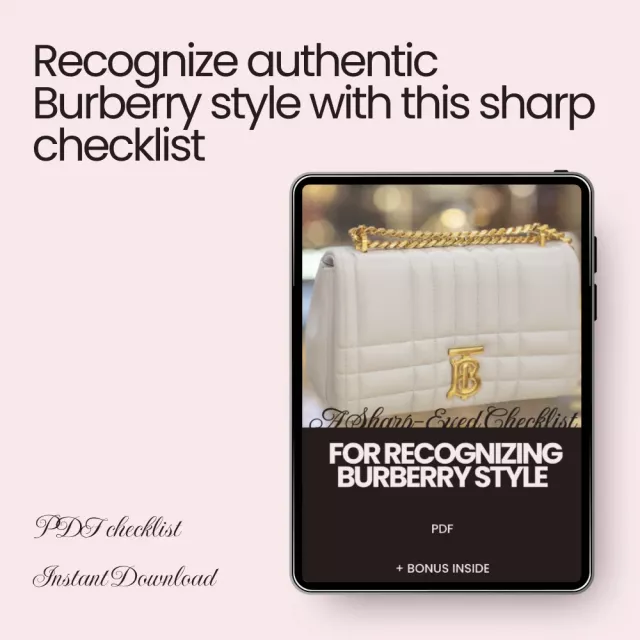
Discover the Key to Spotting Authentic Burberry Style
If you’re a fashion lover or collector, you know the value of owning genuine Burberry pieces. But with so many replicas out there, it can be challenging to distinguish authentic Burberry style from counterfeits. Our A Sharp-Eyed Checklist for Recognizing Burberry Style is the ultimate tool for identifying true Burberry craftsmanship. Whether you’re buying or simply admiring, this digital download will guide you through the unmistakable signs of luxury that define the iconic British brand.
Inside this comprehensive checklist, you’ll uncover essential tips to ensure you’re spotting only the real deal. From fabric quality to subtle design details, you’ll learn how to assess the small things that set Burberry apart from imitations.
What’s Inside the Checklist?
- Look for the Signature Check Pattern: Learn how to examine linings, scarves, trench coat interiors, and handbags to spot the classic Burberry check.
- Inspect the Trench Coat Details Closely: Discover what makes a genuine Burberry trench coat stand out, from epaulettes to stitching quality.
- Study the Fabric Quality: Feel the difference with gabardine and cashmere. Know what to expect from high-quality materials.
- Check the Logo Typography: Understand the modern logo’s clean, balanced lettering and how to spot inconsistencies.
- Notice the Equestrian Motif: Get familiar with the knight-on-horse emblem and its precise details.
- Observe the Color Palette: Recognize the classic Burberry hues—honey beige, deep red, and more.
- Turn the Garment Inside Out: Evaluate the interior craftsmanship, including seams, lining, and labels.
- Assess the Hardware: Identify genuine Burberry buttons, zippers, and buckles with their engraved branding and substantial feel.
- Evaluate Pattern Placement: Know how check patterns should align across seams for a flawless look.
- Pay Attention to Proportions: Spot the sharp, wearable tailoring that defines Burberry’s fit.
- Examine Packaging and Extras: Learn what authentic Burberry packaging and care cards should look like.
- Notice the Balance Between Heritage and Modernity: Appreciate how Burberry blends classic British tailoring with sleek modern designs.
Practical Benefits of This Checklist
With this checklist, you’ll have the tools to confidently identify genuine Burberry items and avoid the disappointment of falling for a counterfeit. Whether you’re a seasoned fashion enthusiast or a first-time shopper, this guide provides all the key points to help you shop smarter and more confidently. And with a downloadable format, you can take it with you wherever you go!
Perfect for:
- Fashion lovers who want to ensure they’re investing in authentic luxury pieces
- Shoppers seeking guidance when purchasing Burberry items online or in-store
- Collectors who want to build a genuine and valuable wardrobe
Why Choose This Checklist?
Unlike other generic guides, A Sharp-Eyed Checklist for Recognizing Burberry Style is specially designed to highlight the unique qualities of Burberry pieces. This checklist covers all the critical aspects of authentic Burberry fashion, from the fabric to the details, ensuring you can make informed decisions every time. It’s more than just a guide—it’s a must-have tool for anyone who appreciates the refined elegance of Burberry’s designs.
Download Now and Shop with Confidence
Don’t miss out on the chance to upgrade your fashion knowledge and shopping experience. Get your A Sharp-Eyed Checklist for Recognizing Burberry Style today and start identifying authentic Burberry pieces like a pro!
Order cancellation
All orders can be cancelled until they are shipped. If your order has been paid and you need to make a change or cancel an order, you must contact us within 12 hours. Once the packaging and shipping process has started, it can no longer be cancelled.
Refunds
Your satisfaction is our #1 priority. Therefore, you can request a refund or reshipment for ordered products if:
- If you did not receive the product within the guaranteed time( 45 days not including 2-5 day processing) you can request a refund or a reshipment.
- If you received the wrong item you can request a refund or a reshipment.
- If you do not want the product you’ve received you may request a refund but you must return the item at your expense and the item must be unused.
We do not issue the refund if:
- Your order did not arrive due to factors within your control (i.e. providing the wrong shipping address)
- Your order did not arrive due to exceptional circumstances outside the control of legendarypicksmarket.shop (i.e. not cleared by customs, delayed by a natural disaster).
- Other exceptional circumstances outside the control of https://legendarypicksmarket.shop
*You can submit refund requests within 15 days after the guaranteed period for delivery (45 days) has expired. You can do it by sending a message on Contact Us page
If you are approved for a refund, then your refund will be processed, and a credit will automatically be applied to your credit card or original method of payment, within 14 days.
Exchanges
If for any reason you would like to exchange your product, perhaps for a different size in clothing. You must contact us first and we will guide you through the steps.
Please do not send your purchase back to us unless we authorise you to do so.
Instant download
Your purchase will be available to download once payment is confirmed.
Instant download items don’t accept returns, exchanges or cancellations. Please contact us if you have any problems








Used the hardware assessment tip at a consignment store last weekend and immediately caught a fake. The buttons felt hollow and lightweight — exactly what this guide warned about. Walked away confident instead of second-guessing myself. This checklist pays for itself on the first use.
The pattern alignment tip across seams is something I never would've noticed on my own.
Turned my trench inside out like the guide suggested and the interior finishing confirmed it's authentic. Neatly bound seams, intentional lining, firmly sewn labels — every detail checked out. Peace of mind in five minutes.
Storm shield, gun flap, D-rings — now I know exactly what to look for
Compact and ridiculously practical.
I buy and resell vintage clothing as a side business and this checklist has become part of my authentication workflow. The logo typography section alone has saved me from purchasing three counterfeits in the past two months — the letter spacing tells you everything if you know what to look for. Before this guide I was relying on gut feeling. Now I have a system.
The gabardine texture description nailed it — smooth yet structured.
Good checklist but could use photos alongside each point. Reading about crisp pattern lines is helpful — seeing them side by side with a fake would be even better.
I inherited a Burberry scarf from my grandmother and always wondered if it was real. Went through every checkpoint — cashmere density, check pattern alignment, label stitching — and it passed everything. Knowing it's genuine made an already sentimental piece even more meaningful.
The equestrian motif details caught things I'd never have spotted.
Short enough to memorize before hitting a vintage shop.
Helpful starting point but some of the criteria feel like they apply to any luxury brand, not just Burberry specifically. The trench coat section and the check pattern tips are the most unique and useful parts.
The packaging section was a detail I never thought to check. Pixelated care cards — that's such a specific tell and now I can't unsee it. This guide trains your eye in ways that stick.
Blurry edges on the check pattern being a red flag — noted and already using it.
I shop secondhand almost exclusively and authentication has always been my biggest anxiety. This checklist gave me a concrete process instead of just hoping for the best. The interior finishing section is what I come back to most — turning garments inside out tells you more than the outside ever will. Seam quality, lining feel, label attachment — those three things alone have filtered out at least five questionable pieces in the last month. Printed it out and keep a folded copy in my bag.
️✅
Wish I'd had this before I bought a knockoff scarf last year. The cashmere shedding warning would've tipped me off immediately.
Quick read with lasting impact on how I evaluate quality.
The proportions section was interesting but a bit vague. How coats should skim without clinging is subjective — more specific measurements or fit references would strengthen that point. The rest of the checklist is sharp though.
Engraved branding on buttons with consistent depth — that's the kind of micro-detail that separates a real authentication guide from a generic one. Now I check every button before I check the price tag.
Every point is actionable. No filler.
Solid for spotting fakes but doesn't cover Burberry's newer lines or more recent design shifts. Feels focused on heritage pieces, which is fine if that's what you're shopping for.
The color palette observation tip helped me spot an off-tone scarf at a market. The red was washed out instead of deep and saturated. Walked away thanks to this guide.
Honey beige, deep red, forest green — now I see the palette everywhere.
I run an online vintage clothing shop and my customers constantly ask how I verify authenticity. I used to spend ages explaining my process piece by piece. Now I just share this checklist. The trench coat section alone — epaulettes, storm shield, gun flap, D-rings, stitching around the collar — covers everything I'd normally walk someone through in a fifteen-minute video. The fact that it also addresses hardware weight, pattern alignment across seams, and interior finishing means my customers can cross-reference what they receive against a clear standard. Returns dropped noticeably after I started including this in my packaging. It builds trust in a way my word alone couldn't.
The heritage-and-modernity balance point at the end ties everything together nicely ❤️
Downloaded it for the trench coat tips, stayed for the fabric education.
Decent guide. Some points are fairly obvious if you've ever handled luxury goods, but the Burberry-specific details like the equestrian motif precision and check stripe alignment are genuinely useful.
Checked my mother's vintage trench using this and confirmed every detail. Storm shield, D-rings, gabardine texture — all present. She bought it in the eighties and it's still impeccable. This guide gave me the vocabulary to understand why.
The font spacing detail for spotting counterfeits is brilliant.
⭐
Interior seam quality — that's the checkpoint I use every single time now.
Good but not great. Covers recognition well but I expected more context on how Burberry's design markers have changed across decades. A vintage piece from the nineties won't match all of these criteria and the guide doesn't acknowledge that.
Took this checklist to a flea market and vetted three scarves in under ten minutes. One passed, two didn't — the check lines were uneven and the cashmere felt fuzzy instead of dense. Would have bought all three without this guide.
Concise, specific, and immediately usable.
The knight-on-horse emblem details were something I'd never looked at closely. Horse legs clearly defined, shield precise, banner legible — now I notice when something's off. Changed how I evaluate every piece that carries the motif.
Twelve checkpoints and not a single wasted word.
Useful but I wanted more on bags and accessories specifically. The trench and scarf sections are strong — everything else gets lighter treatment.
I'm a personal shopper and I keep this checklist on my phone for every consignment appointment. The pattern placement section is what I reference most — checking that lines align symmetrically across seams is the fastest way to separate authentic from counterfeit when you're working quickly. Clients trust the process more when they can see me running through specific criteria rather than just saying it looks right.
The dust bag and care card tips caught me off guard — never thought to check packaging quality.
Simple but effective. Read it once and the details stick.
Some of the fabric descriptions are hard to apply without a reference piece in hand. Telling someone gabardine should feel smooth yet structured is useful if you've felt the real thing — less useful if you haven't. Still, the visual checks are solid on their own.
The stitching-around-the-collar tip is one I use on every coat now, not just Burberry.
Pattern matching across front panels when a coat closes — that detail alone makes this worth reading. It's the kind of quality indicator that's impossible to unsee once you know it. Checked every coat in my closet after reading this and you can immediately tell which ones were cut with care.
My go-to reference before any vintage purchase.
✅
The balance between heritage and modernity section is what elevates this beyond a simple authentication list. It teaches you to recognize the brand's design philosophy, not just its logos. That distinction matters if you care about understanding fashion rather than just spotting fakes.
Shared this with my brother who nearly bought a fake trench online. The letter spacing tip saved him.
Solid authentication basics. Could go deeper on seasonal collection variations and how design cues shift between mainline and diffusion pieces, but as a quick reference it works well.
Hollow zippers and lightweight buckles — two things I'll never overlook again.
I bought a Burberry bag from a resale platform last month and used every single checkpoint in this guide before accepting the delivery. Hardware weight, logo spacing, lining quality, stitching precision — each one checked out. The previous version of me would have just looked at it and hoped for the best. Now I have a system and I trust what I'm buying. The confidence alone is worth more than the price of the bag.
Memorized the trench details in one read. Practical and efficient.
Fine for casual buyers. Anyone serious about authentication will need more than this, but it's a solid starting point that covers the essentials without overwhelming you.
The cashmere shedding test is so simple and so effective.
This guide does something most authentication resources don't — it teaches you to feel quality, not just see it. The gabardine description, the hardware weight, the cashmere density — those tactile cues are what actually separate real expertise from surface-level checking. I've been collecting vintage Burberry for about eight years now and I still learned two new things from this PDF. The pattern alignment across seams was something I'd been doing instinctively but never articulated as a formal checkpoint. Having it written down means I can teach it to other collectors in my community. The equestrian motif precision tip was also new to me — I'd been looking at the overall shape but never zooming in on the horse's legs and shield definition specifically. Clean, expert-level content disguised as a simple checklist.
Storm shield across the upper back — didn't even know that had a name until this guide.
Practical checklist but the promotional section at the end felt disconnected. The authentication content itself is genuinely well done.
Clean lines rather than excessive embellishment — that proportions tip applies to so much more than just Burberry.
Five pages, twelve checkpoints, and I'm already shopping smarter.
The label-attachment detail in the interior finishing section is sneakily useful. Firmly sewn with clean edges versus loose or fraying — it takes two seconds to check and tells you a lot about overall construction quality
Helpful enough but I expected deeper material on distinguishing between Burberry's various lines and price points. The guide treats everything as one category.
D-rings on the belt — such a small detail but now I check every time.
Read it, saved it, already used it twice at consignment shops.
Saturated bold colors versus washed out — that color palette tip flagged a suspicious jacket I was about to buy. The red was dull and muted in a way that didn't match what this guide describes. Checked the hardware next and the buttons felt cheap. Two checkpoints, thirty seconds, saved me from a counterfeit.
The checklist format makes it easy to work through methodically.
Good quick reference. Not comprehensive enough for serious collectors but covers the fundamentals well for everyday shoppers.
Crisp check lines, even spacing, no blur — three words that now run through my head every time I pick up anything with that pattern.
Taught me more about construction quality than most full-length fashion books