


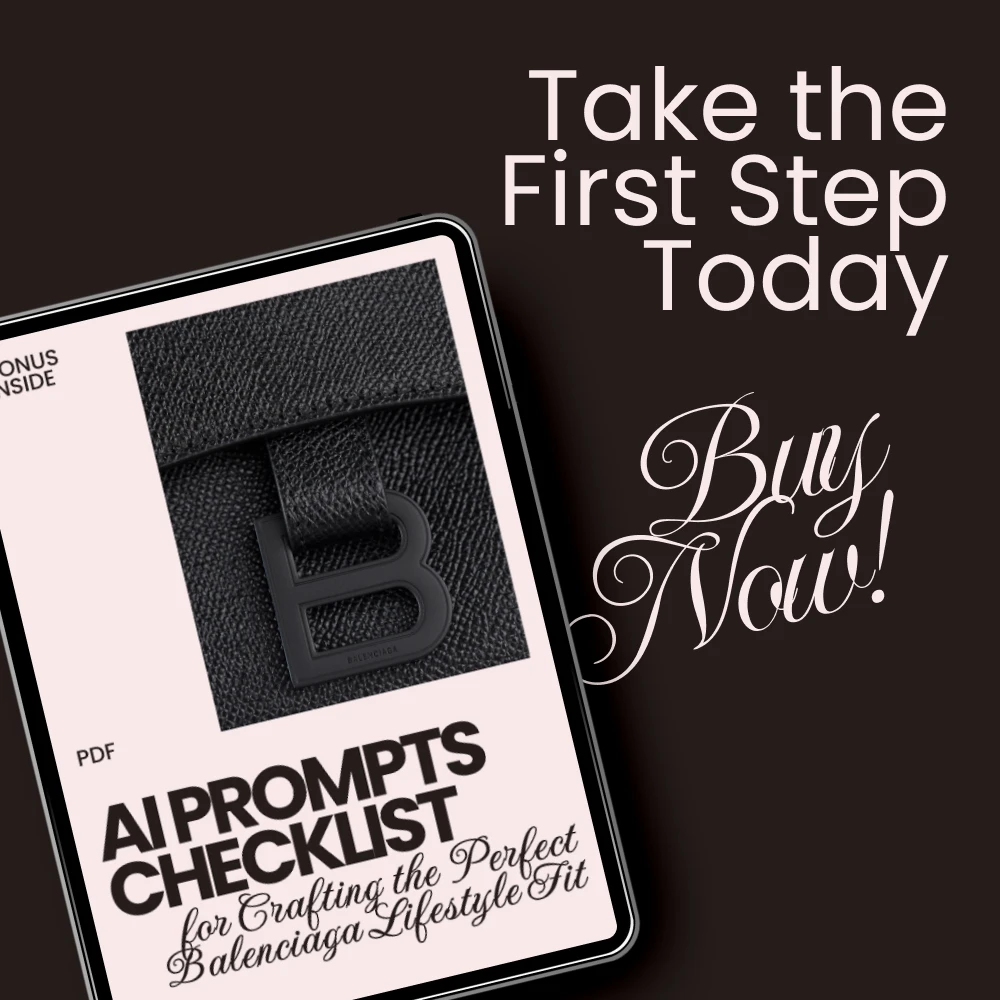
Transform Your Balenciaga Fits with AI-Powered Precision
Ready to create the ultimate Balenciaga look? With the AI Prompts Checklist for Crafting the Perfect Balenciaga Lifestyle Fit, you can now effortlessly style and fine-tune your fashion creations using AI prompts that focus on every detail. Whether you’re working with oversized coats, logo hoodies, or statement accessories, this checklist will help you define and perfect your Balenciaga-inspired style—down to the last pixel. Unlock your fashion potential and craft that signature Balenciaga lifestyle look with AI assistance that understands the vibe.
- Define the Mood – Set the tone for your outfit with AI prompts for various styles: edgy streetwear, high-fashion avant-garde, or sleek minimalist.
- Pick Your Key Piece – Focus on your central Balenciaga item—be it sneakers, oversized coats, or iconic accessories—and guide the AI to match.
- Specify the Setting – Choose the perfect backdrop for your Balenciaga look: urban streets, luxury apartments, or runway stages.
- Detail the Silhouette – Fine-tune the fit and proportions with prompts about oversized jackets, tapered pants, and dramatic silhouettes.
- Incorporate Textures & Fabrics – Elevate your look with leather, mesh, technical fabrics, or distressed denim for added sensory depth.
- Add Color Palette Instructions – Whether it’s monochrome, muted neutrals, or Balenciaga’s signature pastels, ensure the AI reflects your vision.
- Include Accessories & Props – Guide the AI on which bags, sunglasses, belts, or tech gadgets should accompany your fit.
- Define Action or Pose – Bring your AI output to life with prompts on how to pose, walk, or move your digital model.
- Layer in Lifestyle Context – Incorporate urban commuting, coffee culture, or high-end nightlife into the scene for a true Balenciaga vibe.
- Refine with Art & Photography Style – Suggest visual styles like cinematic, editorial, or surreal to match the Balenciaga aesthetic.
- Test & Iterate – Tweak and test prompts until you get the perfect digital Balenciaga look.
- Add Signature Balenciaga Flair – Perfect the fit with AI prompts that emphasize Balenciaga’s branding, exaggerated proportions, and unexpected combinations.
Why Choose This AI Prompts Checklist?
This AI prompts checklist is perfect for fashion enthusiasts, digital designers, and anyone looking to create stylish, Balenciaga-inspired outfits using AI. With carefully crafted prompts that guide every aspect of your digital look—from color palettes to pose suggestions—this checklist ensures that your creations have that unmistakable Balenciaga edge.
Unlike other digital resources, this checklist focuses specifically on crafting the perfect Balenciaga lifestyle fit through AI. You won’t just get generic outfit suggestions; you’ll get tailored prompts that guide you in creating Balenciaga looks that resonate with fashion-forward street culture, high-end aesthetics, and timeless design.
Download Today and Begin Crafting Your AI-Enhanced Balenciaga Style!
Ready to elevate your digital designs and fashion ideas? Download the AI Prompts Checklist for Crafting the Perfect Balenciaga Lifestyle Fit now and start designing your Balenciaga-inspired outfits with precision. Whether you’re a fashion designer, content creator, or style enthusiast, this digital resource will help you create standout, lifestyle-focused looks. Don’t miss out—download now and start creating the next level of Balenciaga style today!
Order cancellation
All orders can be cancelled until they are shipped. If your order has been paid and you need to make a change or cancel an order, you must contact us within 12 hours. Once the packaging and shipping process has started, it can no longer be cancelled.
Refunds
Your satisfaction is our #1 priority. Therefore, you can request a refund or reshipment for ordered products if:
- If you did not receive the product within the guaranteed time( 45 days not including 2-5 day processing) you can request a refund or a reshipment.
- If you received the wrong item you can request a refund or a reshipment.
- If you do not want the product you’ve received you may request a refund but you must return the item at your expense and the item must be unused.
We do not issue the refund if:
- Your order did not arrive due to factors within your control (i.e. providing the wrong shipping address)
- Your order did not arrive due to exceptional circumstances outside the control of legendarypicksmarket.shop (i.e. not cleared by customs, delayed by a natural disaster).
- Other exceptional circumstances outside the control of https://legendarypicksmarket.shop
*You can submit refund requests within 15 days after the guaranteed period for delivery (45 days) has expired. You can do it by sending a message on Contact Us page
If you are approved for a refund, then your refund will be processed, and a credit will automatically be applied to your credit card or original method of payment, within 14 days.
Exchanges
If for any reason you would like to exchange your product, perhaps for a different size in clothing. You must contact us first and we will guide you through the steps.
Please do not send your purchase back to us unless we authorise you to do so.
Instant download
Your purchase will be available to download once payment is confirmed.
Instant download items don’t accept returns, exchanges or cancellations. Please contact us if you have any problems








The mood-first approach completely changed my MidJourney results. I used to jump straight into describing clothes and the outputs felt random. Starting with edgy streetwear versus sleek minimalist as a framing decision meant every detail I added after that pointed in the same direction. My first prompt using this checklist produced the most cohesive Balenciaga-inspired image I've ever generated.
I create fashion content for TikTok and this checklist cut my prompt iteration time in half. Before, I'd run fifteen variations trying to get the right vibe. Now I work through mood, key piece, setting, and silhouette in order and the first output is usually 80% there. The texture and fabric tip about specifying leather, mesh, or technical fabrics added a tactile quality my images were always missing. The lifestyle context layer — referencing coffee culture or urban commuting — made my AI-generated lookbooks feel like actual street photography instead of floating outfits on blank backgrounds. I've generated over forty images using this system and my engagement on content featuring them jumped noticeably compared to posts with my older AI visuals.
Specifying the setting made my outputs go from flat to cinematic overnight.
The color palette tip about Balenciaga pastels was a detail I'd never thought to include in prompts
Neon-lit alleyways as a backdrop — tried it once and now it's my default scene for streetwear prompts.
The action and pose tip transformed my AI images from mannequin shots to lifestyle visuals. Adding mid-turn or leaning against a wall gave the outputs a sense of movement that made my mood boards look professional for the first time. Combined with the editorial photography style suggestion, my client presentations went from decent to impressive.
Distressed denim as a texture call-out added exactly the rawness my prompts were missing.
Good checklist for AI fashion prompting but the accessories tip could be more specific about how props interact with the overall composition. Saying to include statement bags and sunglasses is fine, but guidance on when props add versus clutter would improve the outputs. The mood, setting, and art style tips are the strongest three and those alone elevated my workflow.
Test and iterate — the permission to run multiple rounds and tweak adjectives made me stop expecting perfection on the first try.
The silhouette detail tip about dramatic shoulders and layered tees gave my prompts the specificity AI tools need to produce something that actually reads as Balenciaga rather than generic fashion. I'd been using vague descriptors before and wondering why results looked off-brand.
⭐
Cinematic versus editorial versus surreal — naming the photography style in the prompt was the variable I'd been ignoring.
The lifestyle context layer referencing high-end nightlife made my outputs feel lived-in instead of staged. Adding a coffee cup or urban commuting backdrop grounded the fashion in a real scenario and the AI responded to that context beautifully.
Twelve steps that turn vague prompts into precise creative briefs.
Useful framework but the define-the-mood tip could include example prompt fragments for each mood option. Knowing the choices are edgy streetwear, avant-garde, or sleek minimalist is helpful, but showing how those translate into actual prompt language would save iteration time. The texture, setting, and art style tips compensate by being specific enough to plug directly into any AI tool.
Monochrome versus bold contrasts versus Balenciaga pastels — the palette options alone solved my color prompting problem.
I design for a streetwear brand and use AI for concept visualization before production. This checklist became my pre-prompting ritual. Mood sets tone, key piece anchors the concept, setting provides context, silhouette defines shape — working through those four in sequence before touching anything else meant my first-round outputs were consistently usable. The texture tip about mentioning mesh and technical fabrics solved a recurring issue where my AI images looked too smooth and generic. I've generated concept boards for three collections using this system and each one landed with my team faster than anything I'd mocked up manually. The test-and-iterate tip also normalized the process — I stopped treating every prompt like it needed to be perfect and started treating it like sketching.
Walking, leaning, sitting, mid-turn — four pose words that made every output feel dynamic.
The key piece tip about identifying whether the focus is sneakers, coat, hoodie, or accessory first eliminated the scattered feeling my prompts used to have.
Exaggerated proportions as signature Balenciaga flair — that last tip tied every other element together.
Solid prompting guide but the lifestyle context tip overlaps somewhat with the setting tip. Both ask you to think about environment and scenario. Combining them into one richer prompt layer would free up space for a tip on lighting or time-of-day, which significantly affects AI image mood. The silhouette and texture tips are the most technically useful and the ones I reference every session.
Urban streets versus luxury apartments as backdrops — the setting options gave me range I wasn't exploring before.
❤️
The high-contrast photography style suggestion matched the Balenciaga aesthetic so well that my client assumed I'd hired a photographer for the mood board.
Tweaking adjectives between rounds — that single iteration tip improved my output quality more than any other advice I've read on AI prompting.
I went through all twelve tips before a single prompt and the result was the first AI image I've ever generated that I'd actually put in a portfolio. The mood was edgy streetwear, key piece was an oversized coat, setting was a neon-lit alleyway, silhouette included dramatic shoulders, texture was leather over mesh, palette was monochrome with a neon accent, and the art style was cinematic. Every layer added something distinct and the composition felt intentional rather than random.
Leather, mesh, and technical fabrics — three material callouts that gave my prompts tactile depth.
This checklist treats AI prompting as a creative process rather than a keyword dump, and that's exactly the shift I needed.
Helpful starting framework but the signature Balenciaga flair tip at the end could come earlier in the process. Branding and exaggerated proportions should inform every other decision — mood, silhouette, color — rather than being an afterthought at step twelve. Reordering it to the top would make the entire sequence stronger. The texture and photography style tips are excellent regardless of order.
Street culture nuances as a lifestyle layer — my AI outputs finally look like they belong in a real neighborhood.
Tapered pants and oversized jackets in the silhouette tip — those two proportion calls fixed my most common output issue
Good prompting checklist overall but the color palette tip doesn't address how colors interact with the specified setting. Monochrome looks different against a neon alleyway versus a luxury apartment, and the prompt should account for that. The mood-first and key-piece-second sequence is strong structurally and I've adopted it for all my AI work beyond just fashion.
The surreal art style option opened up a whole visual direction I hadn't tried before.
Swapping accessories between prompt rounds to see how each changes the composition — that iteration advice made my workflow feel like actual designing instead of guessing.
⭐
Picking a key piece first and letting it guide every other prompt decision — that anchor logic is transferable to any AI visual work, not just fashion.
I use this for client mood boards now. The twelve-step sequence produces consistent, on-brand results because each step constrains the next in a way that prevents the AI from drifting. Mood narrows style, key piece narrows focus, setting narrows composition, and everything after that adds resolution. My turnaround time on concept presentations dropped from two days to four hours.
Coffee culture as a lifestyle context layer — such a small addition that made a huge difference in output realism.
The texture tip about mesh and technical fabrics produced outputs that finally looked like actual garments instead of painted surfaces.
Functional prompting guide but the test-and-iterate point reads more as general AI advice than something specific to Balenciaga styling. Every AI prompt guide says to iterate. Where this checklist shines is in the Balenciaga-specific layers — mood options, signature flair, and the proportions vocabulary. Those are the tips that produce results you can't get from generic prompting tutorials.
Dramatic shoulders in the silhouette — two words that made my AI outputs read as Balenciaga instantly.
This is the prompting workflow I keep open in a second tab during every MidJourney session. The sequence from mood to key piece to setting to silhouette builds a prompt that's specific enough to produce usable first drafts and structured enough to know exactly which variable to tweak when something's off. The photography style layer was the one I'd been skipping before and adding editorial or cinematic consistently elevated the output from concept sketch to presentation-ready visual.
Unexpected combinations as signature flair — that permission to be weird produced my best outputs.
Decent checklist for AI beginners but the accessory and lifestyle context tips need clearer boundaries. When should I add a tech gadget versus a statement bag? When does coffee culture enhance the scene versus distract from the outfit? Without that guidance the tips risk adding clutter instead of depth. The core sequence of mood, key piece, setting, and silhouette is strong and I use those four every time.
Muted neutrals as a palette instruction — my outputs went from chaotic to cohesive in one prompt revision.
The fashion runway stage as a setting option produced outputs that looked like actual show photography.
I built a full lookbook for a streetwear pitch using every tip in order. Mood was avant-garde, key piece was an oversized coat with dramatic shoulders, setting was a brutalist parking garage, textures were technical fabric over mesh, palette was muted gray with one red accent, accessories were angular sunglasses, pose was mid-turn, lifestyle context was urban commuting, and the art style was cinematic. The twelve images I generated looked cohesive enough that the client thought they were styled shoots. I've since templated this checklist into my creative brief process for every new project. The iteration tip also shifted my mindset — I now treat the first output as a draft, not a final product, and the quality difference is massive.
Adjusting setting details between iterations — the most practical prompting advice in the entire checklist
Sensory depth through fabric mentions — leather and mesh in the prompt changed flat AI surfaces into believable textures.
Helpful prompt structure but some tips could be consolidated. Setting and lifestyle context serve similar purposes, and mood and signature flair both address overall vibe. Tightening to eight or nine steps would make the checklist faster to use without losing anything. The silhouette, texture, and art style tips are the three I return to most and those are worth the download alone.
Logo hoodie as a key piece anchor — that single prompt decision cascaded into the most coherent AI image I've produced.
Twelve structured steps that turn AI prompting from random to repeatable — exactly what my creative process needed.