


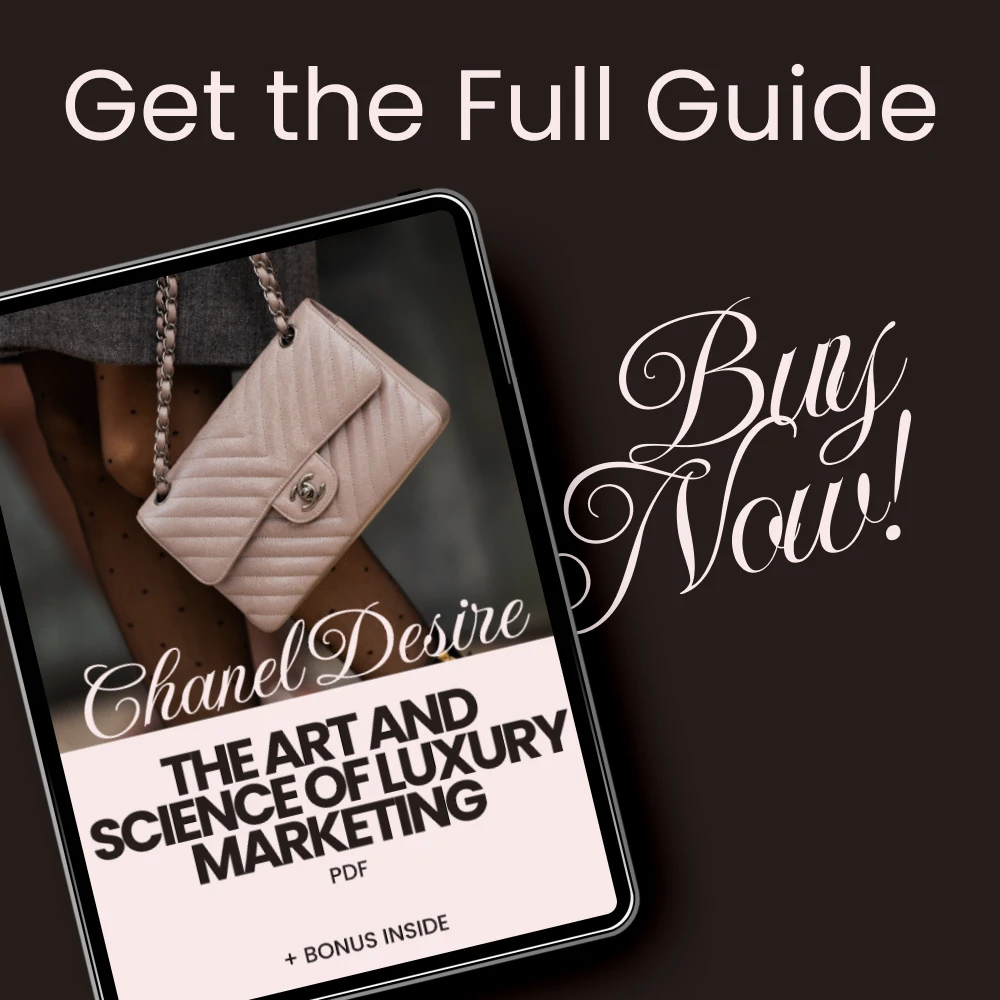
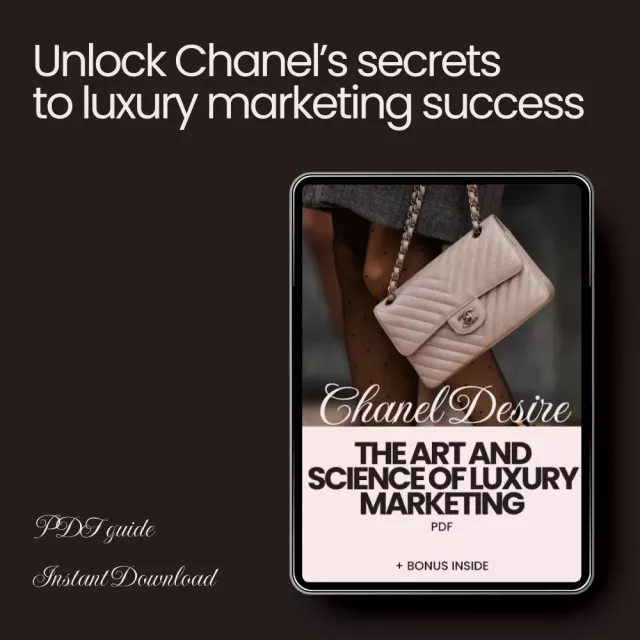
Unlock the Secrets of Luxury Marketing with “Chanel Desire: The Art and Science of Luxury Marketing” Guide
Step into the world of high-end marketing with “Chanel Desire: The Art and Science of Luxury Marketing.” This expertly crafted guide takes you behind the scenes of one of the most iconic luxury brands—Chanel. Discover how the legendary fashion house has mastered the art of desire and learn how you can apply these proven strategies to your own brand. Whether you’re a marketing professional or a business owner in the luxury space, this guide will help you build desire, create exclusivity, and cultivate brand loyalty.
Key Features of “Chanel Desire: The Art and Science of Luxury Marketing”
- Chapter 1: The Allure of Desire – Dive into the psychology behind luxury desire, and understand how Chanel crafts its unique narrative to make their products not just items, but coveted icons.
- Chapter 2: The Mechanics of Chanel Marketing – Explore the powerful tools Chanel uses, from visual storytelling and celebrity influencers to limited editions that create exclusivity and scarcity.
- Chapter 3: Lessons from Chanel – Learn from case studies like Chanel No. 5 and avoid common pitfalls in luxury marketing. Plus, discover how AI can enhance your marketing efforts responsibly.
- Chapter 4: Bringing Chanel Desire Into Your Strategy – Practical tips on adapting Chanel’s luxury marketing methods for your own brand, including AI prompts and campaign planning strategies.
Why You Need “Chanel Desire: The Art and Science of Luxury Marketing”
This guide is perfect for entrepreneurs, marketers, and luxury brand enthusiasts looking to understand the inner workings of luxury marketing. Whether you’re just starting out or have years of experience, the insights provided are designed to elevate your marketing strategy to the next level. By embracing the core principles behind Chanel’s success, you’ll discover how to make your products irresistible, how to tell stories that resonate with your audience, and how to create a brand that people crave.
What makes this guide different? Unlike other resources, “Chanel Desire: The Art and Science of Luxury Marketing” offers a deep dive into one of the most prestigious brands in the world, providing you with actionable steps and real-world case studies. You won’t just learn theory; you’ll get a practical roadmap to create your own desire-driven marketing campaigns.
Get Started Today
Ready to bring luxury marketing to your brand? Don’t miss out on the opportunity to learn from the masters. Download “Chanel Desire: The Art and Science of Luxury Marketing” now and start implementing the strategies that will set your brand apart. Transform the way you market your products and create lasting desire with just one click!
Order cancellation
All orders can be cancelled until they are shipped. If your order has been paid and you need to make a change or cancel an order, you must contact us within 12 hours. Once the packaging and shipping process has started, it can no longer be cancelled.
Refunds
Your satisfaction is our #1 priority. Therefore, you can request a refund or reshipment for ordered products if:
- If you did not receive the product within the guaranteed time( 45 days not including 2-5 day processing) you can request a refund or a reshipment.
- If you received the wrong item you can request a refund or a reshipment.
- If you do not want the product you’ve received you may request a refund but you must return the item at your expense and the item must be unused.
We do not issue the refund if:
- Your order did not arrive due to factors within your control (i.e. providing the wrong shipping address)
- Your order did not arrive due to exceptional circumstances outside the control of legendarypicksmarket.shop (i.e. not cleared by customs, delayed by a natural disaster).
- Other exceptional circumstances outside the control of https://legendarypicksmarket.shop
*You can submit refund requests within 15 days after the guaranteed period for delivery (45 days) has expired. You can do it by sending a message on Contact Us page
If you are approved for a refund, then your refund will be processed, and a credit will automatically be applied to your credit card or original method of payment, within 14 days.
Exchanges
If for any reason you would like to exchange your product, perhaps for a different size in clothing. You must contact us first and we will guide you through the steps.
Please do not send your purchase back to us unless we authorise you to do so.
Instant download
Your purchase will be available to download once payment is confirmed.
Instant download items don’t accept returns, exchanges or cancellations. Please contact us if you have any problems








The Chanel No. 5 case study alone taught me more about desire-driven marketing than my MBA did.
Used the AI prompt for luxury campaign concepts and got three usable ideas in five minutes. The guide frames AI as a creative assistant rather than a replacement, which is exactly the right take for anyone working in premium branding.
The section on choosing brand ambassadors based on values alignment instead of raw fame was a lightbulb moment for our team.
Finally a marketing guide that understands luxury isn't about features — it's about emotion.
I run a small jewelry brand and was stuck treating my products like commodities. The mini exercise about turning a product from item to icon — listing emotional benefits, tying it to a cultural narrative, writing a one-line slogan — forced me to rethink everything. I rewrote our homepage copy that same evening. Within two weeks our email click-through rate jumped noticeably. The section on crafting scarcity without compromising your core line gave me permission to experiment with a limited drop, and it sold out in three days.
The overexposure warning about making luxury too accessible hit close to home.
Shared the predictive scarcity prompt with my analytics team immediately.
Clean structure and the exercises actually make you think rather than just read passively. The five-step campaign planning framework at the end is something I keep coming back to.
The visual storytelling breakdown changed how I brief my creative team.
I've read dozens of luxury marketing PDFs and most are surface-level fluff. This one connects psychology to execution in a way that's actually useful. The part about emotion over product features — using the No. 5 film campaign as the example — reframed how I think about our own video content. We were leading with specs and ingredients when we should have been leading with feeling. Applied the storytelling-first approach to our latest launch video and engagement tripled compared to the previous one.
The misaligned influencer section is required reading for anyone managing brand partnerships.
Concise, practical, and respects your time. Rare combination for a marketing guide.
The demand elasticity concept — using AI to model how scarcity affects desire vs accessibility — gave my team a framework we didn't have before. We've been guessing at production quantities for limited runs and this made the case for a data-driven approach.
✨⭐
The lesson about Chanel maintaining brand voice consistency while evolving storytelling techniques across decades — that nuance is what separates this from generic marketing advice.
Pulled three AI prompts directly from this and used them in a client presentation
The celebrity influence section could use a few more modern examples beyond the ones mentioned, but the core principle about values alignment over fame is spot-on and well argued.
I manage marketing for a boutique skincare brand and this shifted my entire strategy. Before reading this I was focused on product ingredients and clinical results — functional stuff. The guide made me realize I was selling science when I should have been selling identity. The exercise about mapping emotional benefits helped me articulate what our customers actually feel when they use our products. I rewrote our campaign brief using the heritage-meets-aspiration framework and even our designers said the creative direction felt sharper.
Smart take on why AI should support craftsmanship, not replace it.
Every brand strategist should read the section on common luxury marketing pitfalls.
The mood board prompt alone saved me hours of creative direction work.
Read it in one sitting and immediately rewrote our brand positioning doc.
The insight that emotional resonance drives desire more than product placement was the kind of principle I needed spelled out clearly. Been applying it to our social content and the engagement difference is obvious.
The part about crafting scarcity through storytelling — not just limiting supply — added a layer I hadn't considered.
Wish there were more industry-specific examples beyond fashion and fragrance, but the principles translate well enough if you do the work. The exercises help bridge that gap.
The three-prompt framework for luxury campaigns — visual ideation, copywriting, predictive scarcity — is now pinned on my desk.
❤️✨
This reframed how I think about exclusivity. It's not about limiting access — it's about making access feel earned.
We were about to launch a mass-market influencer campaign when I read the pitfalls section. Pulled the whole thing back and restructured around brand-aligned voices instead. Our creative director thanked me. The guide is blunt about how high reach with low alignment actually damages perceived value — a lesson some very expensive agencies have never learned. The A/B testing tip for AI-generated mood boards gave us a practical way to validate direction before committing budget.
The item-to-icon exercise is deceptively simple but incredibly effective.
Short, sharp, and usable. No wasted pages.
The campaign spotlight tracing No. 5 from the 1920s through the 2000s showed how a single product can stay relevant across generations — that's the real lesson here.
Applied the five-step campaign planning process to a watch brand I consult for. Landed the pitch within a week. The audit-your-brand-story step at the beginning forced us to confront gaps in our emotional positioning that we'd been ignoring. Crafting the narrative with AI prompts sped up ideation dramatically, and the launch strategy section gave us a ready-made checklist — pre-launch events, limited editions, VIP access. Client said it was the most structured pitch we'd ever delivered.
The ethical note about AI supporting rather than replacing the human touch in luxury — that one sentence grounded the entire guide.
Sent this to my entire marketing team on Monday morning.
The cultural shifts warning resonated — we nearly ran an outdated campaign concept last quarter.
The tagline writing prompt generated better options than our last brainstorm session did
I kept pausing to scribble notes in the margins. The part about framing products as symbols of aspiration rather than functional objects is something I'll carry into every brief from now on.
The guide convinced me to stop selling products and start selling stories.
I run brand strategy for a mid-tier accessories company and we've always admired Chanel's approach without understanding the mechanics behind it. This guide decoded exactly how desire gets manufactured — the scarcity, the storytelling, the ambassador selection. The mini exercise where you write a 50-word heritage story for your product became our team's warmup for every creative meeting. We tested a limited pre-sale for VIP customers based on the scarcity tips and saw double the conversion rate of our standard launches. Printing this out for every new hire going forward.
Practical without being simplistic. That's hard to pull off in a marketing PDF.
The iterate-and-refine step at the end was a good reminder that luxury marketing isn't a one-shot effort.
⭐
The social media sentiment analysis tip for identifying emerging luxury trends — that's going straight into our Q3 planning.
Clear and well-paced. Each chapter builds on the last without repeating itself.
The distinction between scarcity as a supply tactic versus scarcity as a storytelling device was the sharpest insight in the whole guide.