




Unlock the Secrets Behind Burberry’s Iconic Brand Identity Evolution
Explore the fascinating journey of Burberry, one of the world’s most iconic luxury brands, in our detailed and comprehensive eBook, “The Evolution of Burberry’s Brand Identity.” This digital download takes you through Burberry’s rich history, from its humble beginnings to becoming a global symbol of British craftsmanship and luxury. Whether you’re a designer, brand strategist, or a fashion enthusiast, this guide is your ultimate resource to understand the complexities of Burberry’s transformation and how it became a leader in the luxury market. This is more than just a brand story; it’s a blueprint for navigating brand evolution and strategic repositioning.
Key Features:
- In-depth analysis of the origins of Burberry’s brand identity, including the vision of Thomas Burberry and the development of iconic brand codes like the check, crest, and craftsmanship.
- Detailed insights into Burberry’s challenges during the 1980s and 1990s, including issues with licensing, brand dilution, and lessons learned from these struggles.
- Strategies for Burberry’s dramatic turnaround and the role of leadership in reshaping the brand’s prestige and market positioning.
- Exploration of Burberry’s digital transformation with early social media adoption and innovative campaigns such as “Art of the Trench.”
- Insights into major visual identity shifts, including Riccardo Tisci’s rebrand and Daniel Lee’s return to the iconic equestrian knight symbol.
- Practical lessons on balancing heritage with modernity, focusing on sustainability, innovation, and the strategic use of Britishness in branding.
- Forward-thinking insights into the role of AI in brand identity, offering useful tools and prompts for designers to explore new visual strategies.
Practical Benefits:
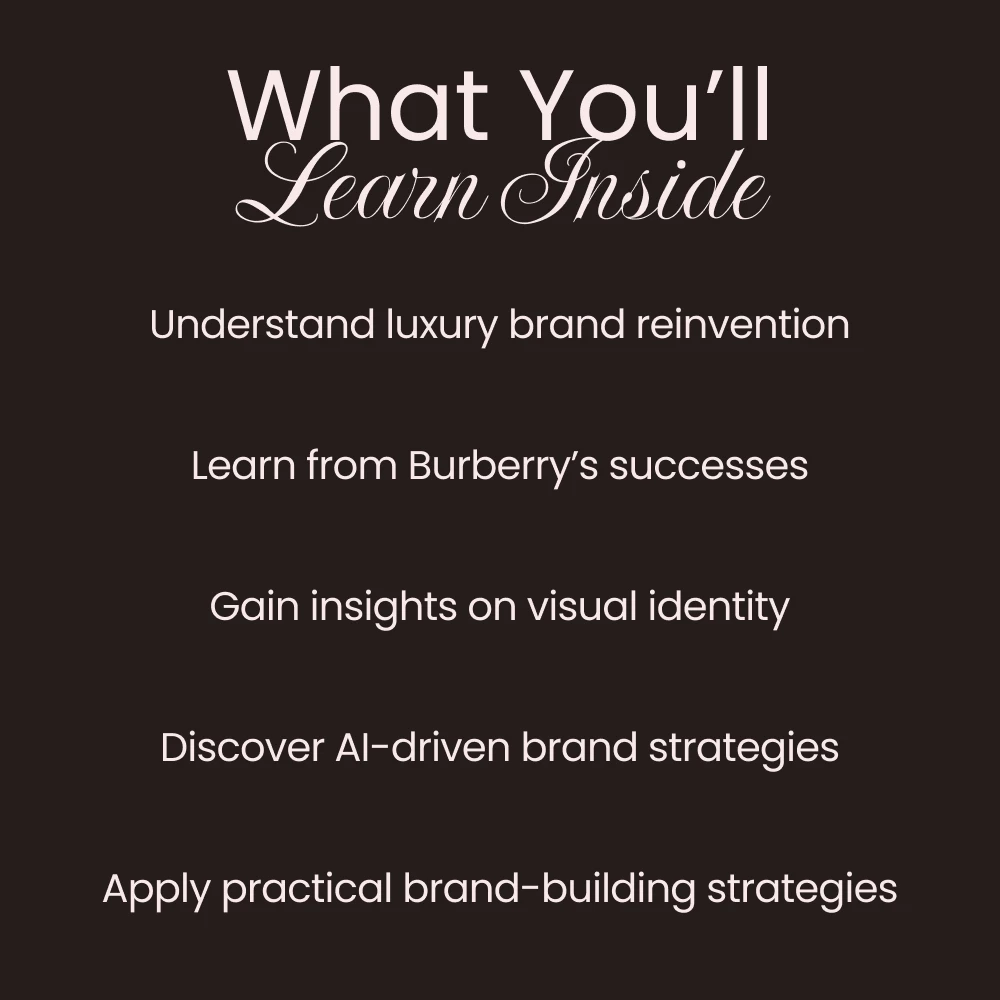
- Gain an understanding of how Burberry overcame major branding challenges to reclaim its position as a luxury leader.
- Learn how digital tools and social media campaigns have played a pivotal role in Burberry’s rise to global prominence.
- Discover how modern luxury brands can maintain a balance between heritage and innovation, ensuring brand longevity and relevance.
- Get actionable insights and practical advice for navigating your own brand’s transformation.
- Explore AI-driven techniques for analyzing and refining brand visuals in today’s digital-first environment.
Who Is This eBook For?
This eBook is perfect for brand managers, fashion designers, marketing professionals, and anyone passionate about luxury brand identity. If you’re looking to understand how iconic brands like Burberry navigate the complexities of heritage, market challenges, and digital innovation, this guide is a must-read.
Why This Guide Is Different
Unlike other general brand strategy resources, “The Evolution of Burberry’s Brand Identity” provides a deep, focused look at one of the most fascinating transformations in luxury brand history. It’s packed with case studies, leadership insights, and practical lessons from Burberry’s journey. Whether you’re interested in branding for fashion or other industries, this guide is a rich, unique resource that offers actionable takeaways you can apply immediately.
Ready to unlock Burberry’s brand secrets? Download your copy of “The Evolution of Burberry’s Brand Identity” today and start learning from one of the most iconic brands in the world. With insights into both the past and future of luxury branding, this guide will help you transform your own approach to brand identity.
Order cancellation
All orders can be cancelled until they are shipped. If your order has been paid and you need to make a change or cancel an order, you must contact us within 12 hours. Once the packaging and shipping process has started, it can no longer be cancelled.
Refunds
Your satisfaction is our #1 priority. Therefore, you can request a refund or reshipment for ordered products if:
- If you did not receive the product within the guaranteed time( 45 days not including 2-5 day processing) you can request a refund or a reshipment.
- If you received the wrong item you can request a refund or a reshipment.
- If you do not want the product you’ve received you may request a refund but you must return the item at your expense and the item must be unused.
We do not issue the refund if:
- Your order did not arrive due to factors within your control (i.e. providing the wrong shipping address)
- Your order did not arrive due to exceptional circumstances outside the control of legendarypicksmarket.shop (i.e. not cleared by customs, delayed by a natural disaster).
- Other exceptional circumstances outside the control of https://legendarypicksmarket.shop
*You can submit refund requests within 15 days after the guaranteed period for delivery (45 days) has expired. You can do it by sending a message on Contact Us page
If you are approved for a refund, then your refund will be processed, and a credit will automatically be applied to your credit card or original method of payment, within 14 days.
Exchanges
If for any reason you would like to exchange your product, perhaps for a different size in clothing. You must contact us first and we will guide you through the steps.
Please do not send your purchase back to us unless we authorise you to do so.
Instant download
Your purchase will be available to download once payment is confirmed.
Instant download items don’t accept returns, exchanges or cancellations. Please contact us if you have any problems








The licensing disaster breakdown is the most honest brand analysis I've read in years. Sent it to my entire team.
That before-and-after turnaround table hit hard — mass-market perception to aspirational luxury, all through design discipline. This is the kind of thinking I want around my own brand every single day.
The gabardine origin story alone justifies the read.
Every brand builder needs to read the section on how overexposure killed the check pattern's prestige. I've been overlicensing my own product and this stopped me cold. Clear, direct, no filler.
Tight writing, real strategy, zero fluff
The Ahrendts and Bailey leadership section is a masterclass in how CEO and creative director alignment actually works. Most guides gloss over that partnership — this one breaks it down.
I run a heritage leather goods brand that was bleeding relevance. We'd been plastering our logo everywhere thinking visibility meant desirability. After reading the brand dilution chapter, I pulled back our logo to just the interior lining and one subtle hardware detail. Within three months, wholesale partners started describing us as premium again without us changing a single product. The turnaround case study gave me the framework and the confidence to say no to short-term licensing deals that would have cheapened us. I now use the practical next steps checklist from the final chapter as a quarterly audit for my team.
Really solid overview of the visual identity shifts. Would have loved more detail on Daniel Lee's specific design decisions beyond the knight logo return — that section felt rushed compared to the Tisci coverage.
Best free PDF on brand repositioning I've found.
The Art of the Trench campaign case study is so well structured. Seeing the actual impact metrics laid out next to the strategy made it real instead of theoretical.
Read it twice in one sitting.
Good content but the AI tools chapter feels generic. The brand strategy sections are excellent — I just wish the AI portion matched that depth instead of listing tools I already know about.
That Equestrian Knight history is fascinating
The point about heritage needing active curation — not just passive inheritance — rewired how I think about my family's textile business. Short PDF, long impact.
⭐❤️
Genuinely surprised by how deep this goes for a free download.
I teach a brand strategy course at university. The licensing-to-dilution pipeline described here is clearer than anything in the textbooks I currently assign. I've already added the case insight table from the brand dilution section to my lecture slides. Students respond to the specificity — short-term gain vs long-term impact laid side by side is more persuasive than theory alone. The turnaround era chapter works perfectly as a follow-up discussion prompt. Only thing missing is competitor comparison data, but for scope this is sharp.
Helpful for understanding the arc but some sections read more like a summary than analysis. The digital pioneer chapter was the strongest — I wanted that level of depth everywhere.
The Tisci rebrand analysis is nuanced and fair.
Saved this to my phone for client meetings.
The way this traces Burberry from a draper's shop to a global icon without ever losing the thread is impressive. Most brand histories jump around — this one builds.
That chav culture positioning failure section doesn't pull punches. Refreshing to see a brand guide acknowledge a genuine cultural crisis instead of sanitizing it.
Decent reference material. I found the practical next steps section a bit vague — would prefer more specific templates or frameworks to apply immediately rather than general advice.
The discipline-over-volume lesson applies to literally every DTC brand right now.
Clean read, well paced, zero wasted pages.
I've spent the last two years building a Scandinavian outerwear label and struggling with when to lean into heritage versus when to modernize. This PDF crystallized the tension perfectly. The section on Britishness as a strategic asset made me rethink how I frame our own Nordic identity — not as decoration but as a genuine differentiator. I rewrote our entire about page the same evening. The visual identity shifts chapter also helped me decide to simplify our logo rather than adding more to it. Sometimes seeing another brand's mistakes saves you from your own.
Livestreaming the runway section was eye-opening
Strong on history, weaker on forward-looking strategy. The AI chapter touches interesting ideas but doesn't go deep enough to actually inform design decisions. The first six chapters carry the weight.
That identity shift diagram — local outfitter to national innovator to global symbol — is burned into my brain now.
Shared it with three colleagues before I even finished.
❤️⭐
The sustainability angle is mentioned but barely developed. Good to see it acknowledged, but given how central it's becoming to luxury positioning, I expected a fuller treatment rather than a few bullet points.
Burberry's comeback story told better here than in most MBA case studies I've read. The connection between retail environment control and brand perception recovery was the insight I needed. I've been letting wholesale partners display our products however they want — that stops now.
The Prorsum logo meaning was new to me.
Product discipline as a luxury strategy isn't talked about enough and this nails why.
I was halfway through a rebrand for my boutique consultancy and almost dropped our original logo for something trendier. Then I read the section on Daniel Lee bringing back the Equestrian Knight and it clicked — you can modernize a heritage symbol without erasing it. I kept our original mark, refined the typography around it, and the response from clients has been overwhelmingly positive. The cyclical nature of brand identity point is subtle but powerful. This PDF saved me from a costly mistake and gave me language to explain the decision to my partners.
The format is great — tables, case studies, clear structure. Makes it easy to reference specific sections later without rereading the whole thing.
Interesting overview but I wanted more on the competitive landscape. How did Burberry's identity shifts compare to what Gucci or Prada were doing at the same time? The isolation from context makes some conclusions feel incomplete.
The scarcity, audience, and positioning triangle from the dilution chapter is now taped to my office wall.
Short, smart, and directly applicable to non-luxury brands too.
✨
I manage brand for a mid-size retail chain and we've been chasing every trend that comes along. The common mistakes section read like a personal call-out. Overextending product lines, neglecting storytelling consistency — we were doing all of it. Pulled my leadership team into a room the next day and walked them through the Burberry turnaround framework. We've since cut two product categories and focused our messaging around three core values. Early results are promising. The guide is free but the thinking behind it isn't amateur.
Good AI tools table but Looka feels like an odd inclusion next to more established options. The brand analysis chapters more than make up for it though.
The digital pioneer chapter belongs in every marketing syllabus.
Made me rethink our entire licensing strategy overnight.
That gabardine-to-global-icon arc is storytelling done right.
I appreciate how the guide covers both wins and failures without becoming either a puff piece or a takedown. The tone stays analytical throughout. The brand dilution table is especially well done — mapping short-term gains against long-term damage makes the cost of bad decisions visceral.
The user-generated content strategy behind Art of the Trench was brilliant and this explains exactly why it worked.
Solid but not groundbreaking. If you've studied luxury brand management, some of these lessons will feel familiar. Still well-organized and useful as a refresher or for sharing with less experienced team members.
The leadership alignment section convinced me to restructure how my cofounder and I divide brand decisions. We'd been pulling in different directions without realizing it. Clear, practical, no jargon.
Finished it on the train — perfect length.
Didn't expect to care this much about a trench coat's military origins but here we are
Every page earns its place.
The framing of Britishness as a strategic asset rather than just aesthetic background is the kind of reframe that changes how you build a brand narrative. Borrowed that lens for our own regional identity work.
I keep coming back to the overexposure lesson — visibility up, exclusivity down. Five words that explain so much about why some brands fade.
Worth it for the turnaround case study tables alone. Genuinely useful data presentation that I can reference during client strategy sessions without needing to explain a wall of text.
Covered a century of brand evolution without ever getting boring. Not easy to do in a PDF this short. The pacing between history, analysis, and practical takeaways keeps you moving forward. Sent it to my design team — three of them messaged me back within the hour.