

Discover the Strategy Behind Timeless Luxury
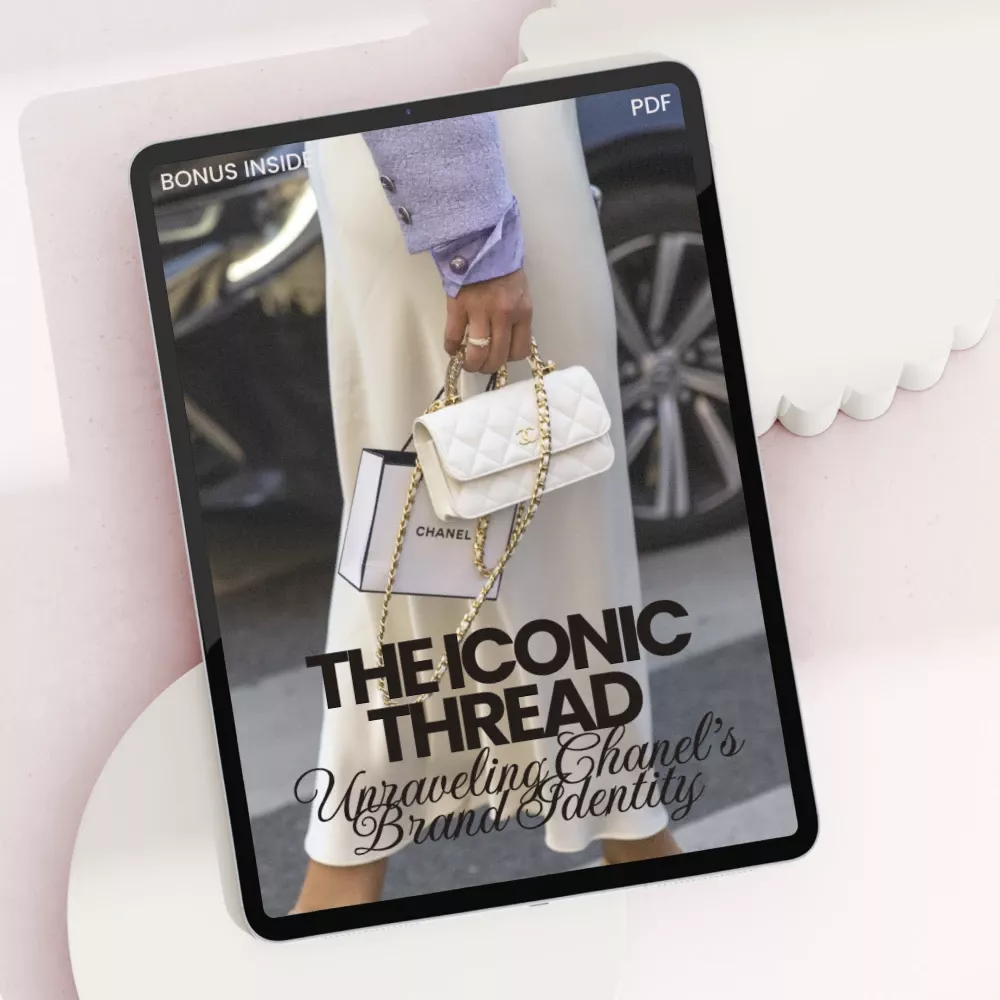
What makes Chanel more than just a fashion house? What transforms a logo into a global symbol of power, elegance, and aspiration? The Iconic Thread: Unraveling Chanel’s Brand Identity is a deep dive into the strategy, storytelling, and visual language behind one of the most recognizable luxury brands in the world. This expertly crafted ebook breaks down chanel brand identity explained in a way that is clear, practical, and inspiring for modern designers, marketers, and entrepreneurs.
If you’ve ever wanted to understand how heritage, minimalism, exclusivity, and innovation come together to create an unforgettable brand, this guide gives you the blueprint.
What’s Inside This eBook
- Chapter 1: The Legacy of Chanel – Explore Coco Chanel’s visionary influence, the rise of the Little Black Dress, and why brand identity is everything in fashion.
- Chapter 2: The Core Elements of Chanel’s Identity – A breakdown of the Double C logo, typography, signature colors, materials, and brand voice.
- Chapter 3: Chanel in the Digital Age – Insights into social media strategy, visual storytelling, AI in fashion, and influencer collaborations.
- Chapter 4: Iconic Campaign Case Studies – From Chanel No.5 storytelling to immersive fashion shows and powerful partnerships.
- Chapter 5: Common Branding Mistakes – Learn why copying style fails and how luxury brands lose value through poor digital execution.
- Chapter 6: Practical Guide for Designers & Marketers – Actionable steps for building cohesive luxury branding, plus AI prompt examples for fashion branding ideas.
- Chapter 7: The Future of Chanel – Sustainability, AI-driven customer experience, and keeping timeless brands relevant.
Who Is This For?
This ebook is perfect for:
- Fashion designers building their own label
- Brand strategists and marketing professionals
- Creative directors and visual storytellers
- Students studying fashion, branding, or luxury marketing
- Entrepreneurs who want to position their brand as premium
Why This Guide Is Different
Unlike surface-level fashion commentary, this guide focuses on strategy, structure, and application. You’re not just reading about Chanel—you’re learning how to apply the principles behind its success. With chanel brand identity explained in clear, actionable language, this ebook bridges theory and execution, combining heritage analysis with modern digital insights and AI-driven opportunities.
It goes beyond aesthetics and reveals the systems, storytelling frameworks, and brand decisions that create lasting luxury.
Practical Benefits You’ll Gain
- Understand how to craft a cohesive luxury brand identity
- Learn how to balance heritage with innovation
- Avoid common branding mistakes that dilute premium perception
- Develop stronger storytelling for campaigns and social media
- Use AI strategically in fashion branding
- Create a brand that feels timeless, not trendy
Instant Digital Download
This is a convenient digital download, giving you immediate access after purchase. Read it on your tablet, laptop, or phone and revisit it anytime you need clarity or inspiration.
Ready to elevate your understanding of luxury branding? Download The Iconic Thread: Unraveling Chanel’s Brand Identity today and start building a brand that doesn’t just look iconic—but becomes unforgettable.
Order cancellation
All orders can be cancelled until they are shipped. If your order has been paid and you need to make a change or cancel an order, you must contact us within 12 hours. Once the packaging and shipping process has started, it can no longer be cancelled.
Refunds
Your satisfaction is our #1 priority. Therefore, you can request a refund or reshipment for ordered products if:
- If you did not receive the product within the guaranteed time( 45 days not including 2-5 day processing) you can request a refund or a reshipment.
- If you received the wrong item you can request a refund or a reshipment.
- If you do not want the product you’ve received you may request a refund but you must return the item at your expense and the item must be unused.
We do not issue the refund if:
- Your order did not arrive due to factors within your control (i.e. providing the wrong shipping address)
- Your order did not arrive due to exceptional circumstances outside the control of legendarypicksmarket.shop (i.e. not cleared by customs, delayed by a natural disaster).
- Other exceptional circumstances outside the control of https://legendarypicksmarket.shop
*You can submit refund requests within 15 days after the guaranteed period for delivery (45 days) has expired. You can do it by sending a message on Contact Us page
If you are approved for a refund, then your refund will be processed, and a credit will automatically be applied to your credit card or original method of payment, within 14 days.
Exchanges
If for any reason you would like to exchange your product, perhaps for a different size in clothing. You must contact us first and we will guide you through the steps.
Please do not send your purchase back to us unless we authorise you to do so.
Instant download
Your purchase will be available to download once payment is confirmed.
Instant download items don’t accept returns, exchanges or cancellations. Please contact us if you have any problems








The Double C logo section reframed how I think about simplicity as a branding decision, not a default.
I'm a brand strategist and have used Chanel as a case study for years, but this guide articulated things I'd felt but never cleanly stated. The distinction between copying style and understanding identity is the most useful single framing in any branding resource I've encountered recently. Using quilted patterns without connecting them to heritage and storytelling is exactly the mistake most Chanel-inspired brands make — stated plainly here for the first time.
Chanel's voice being confident and aspirational but never arrogant — that one line describes the hardest balance in luxury copywriting.
I've been teaching luxury brand management at a design school for six years and regularly update my reading list. This guide earned a place on it specifically for the missteps chapter. My students consistently conflate aesthetic replication with brand identity, and the Chanel examples here make the distinction concrete: using pearls or quilted texture without the underlying philosophy of craftsmanship and storytelling produces pastiche, not prestige. The practical exercise — a brand identity mood board paired with a two or three sentence brand story — is something I now assign in week two. The fashion shows as living campaigns framing is equally strong and genuinely useful for students who haven't yet understood why Chanel invests so heavily in runway spectacle when the collections could be shown more economically.
Coco Chanel replacing corsets with functional, chic silhouettes as both a design and a political act — this guide understands the history.
The chapter on diluting luxury through brand misuse is the one I'll send to colleagues who are considering discount channel distribution The case example is understated but accurate: a temporary sales boost against permanent erosion of perceived exclusivity. Chanel's discipline in protecting that perception is the most underappreciated part of its business strategy, and this guide frames it correctly.
Strong and well-structured throughout, with the practical designer and marketer guide being the most actionable chapter. My one reservation is the AI usage ideas — the suggestion that AI can generate brand-aligned messaging by analyzing existing communications is directionally accurate but oversimplified for anyone who's actually tried to implement it. The guide treats AI as more reliably brand-faithful than it typically is without human oversight at every step.
The 2.55 bag introduced in 1955 with a chain strap for hands-free elegance — still a benchmark of brand consistency seven decades later
✨
The social media strategy section is the most practically transferable chapter for working marketers. Consistency across every platform, experience over product, behind-the-scenes content that creates intimacy while reinforcing craftsmanship — these three principles describe Chanel's digital approach but also describe good luxury social strategy generally. The framing of social media as a digital runway is memorable enough to stick.
Solid foundation on Chanel's history and visual identity, with genuinely useful practical guidance for designers. The AI prompt examples in Chapter 6 are the weakest section — they illustrate the concept but would benefit from sample outputs or honest notes on where AI-generated branding content tends to drift from brand voice. The framework is sound; the AI application needs more grounding.
Understanding that the LBD transformed a color associated with mourning into a symbol of modern elegance made me rethink every design convention I've accepted uncritically.
I came to this guide as someone launching my own accessories brand, genuinely confused about the difference between having a visual identity and having a brand identity. Those feel like the same thing until you read this. The guide makes the distinction through Chanel's example: the Double C logo, the black and white palette, the quilted leather, the tweed — these are visual elements, but they communicate something deeper about resilience, independence, and the original founder's rebellion against restriction. The brand voice section clarified what I'd been missing in my own communications: I had a tone but not a philosophy. Every caption, product description, and campaign I'd written before reading this lacked the question the guide poses directly — what story or value am I communicating? I went back through six months of content after finishing Chapter 5 and the answer in too many cases was: nothing specific, and it showed. I've since rebuilt my brand guidelines from the core values outward, following the step-by-step approach in Chapter 6, and the consistency difference in my new content is visible without explanation. The sustainability angle in Chapter 7 was also useful — I'd been avoiding it as a topic because it felt generic, but the framing of luxury with purpose as an audience expectation rather than a trend shifted how I think about it. The guide is most valuable to people who are building something, not just studying something.
Chanel No.5 launched in 1921 and still culturally relevant — the campaigns section explains exactly why that's not luck.
The Karl Lagerfeld creative direction example earns its space Decades of cohesive narrative that evolved with the times without losing the thread — that's the collaboration standard every luxury brand should measure itself against. The guide correctly frames it as enhancement, not transformation.
The AI chapter is useful conceptually but could engage more critically with where AI content generation tends to produce generic luxury aesthetics rather than brand-specific ones. The note that AI must be guided with brand parameters is correct and important — but that guidance process is where most teams struggle, and the guide moves past it too quickly.
The takeaway that products with strong heritage stay relevant when campaigns reinforce identity rather than chase trends is the principle I've been trying to articulate to clients for two years. Having it stated this cleanly, with No.5 as the evidence, is useful in ways I'll reference repeatedly.
❤️✨
The Grand Palais fashion shows as immersive brand experiences — venue, design, music, models all communicating identity simultaneously — is the most underexplored idea in this guide. I'd read about those shows for years without understanding that every production choice was a branding decision. Seeing it framed that way changed how I watch any fashion show now, not just Chanel's. The practical takeaway that brand events can function as living campaigns where no element is decorative is something I immediately brought to my team. We've since rethought how we approach product launches: what does each touchpoint communicate about who we are, and does the sum of those choices tell a coherent story? The guide gave us a framework for asking that question that Chanel answers better than anyone else.
Brands that ignore sustainability risk losing relevance even if their design is iconic — that's the most important sentence in Chapter 7.
Seven chapters covering legacy, identity elements, digital strategy, campaign case studies, emulation mistakes, designer guidance, and future outlook — each earning its place. The brand audit checklist in the next steps section is immediately actionable, and I appreciate that the guide explicitly includes AI usage rules as something to document in brand guidelines rather than treating AI as separate from the identity framework.
Style can be copied but identity cannot — three chapters build to that conclusion and it lands.