



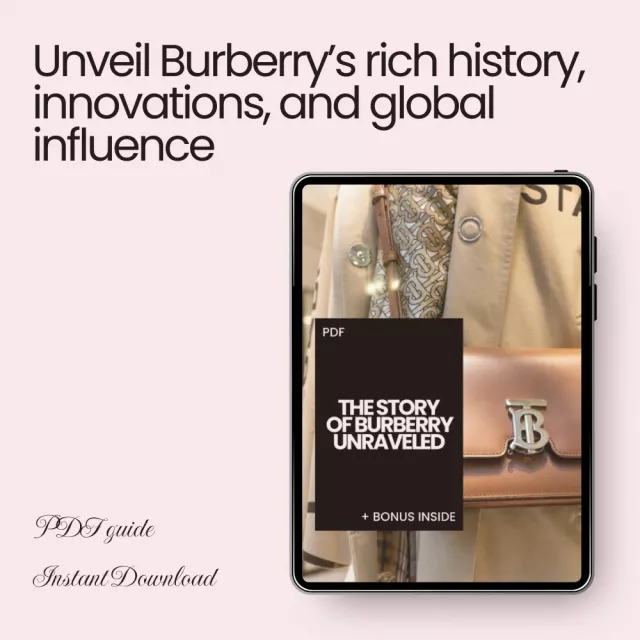
Uncover the Legacy of Burberry with This Comprehensive eBook
Step into the fascinating world of luxury fashion with The Story of Burberry Unraveled, the ultimate eBook for fashion enthusiasts, brand historians, and those captivated by Burberry’s rich heritage. This digital guide provides an in-depth look at the Burberry brand history explained, from its humble beginnings to becoming a global icon. If you’ve ever wondered how Burberry went from a small shop in Basingstoke to dressing royalty, this eBook is your key to unlocking that story.
With a detailed breakdown of key events and milestones, The Story of Burberry Unraveled is perfect for anyone who loves fashion history, luxury branding, or simply wants to understand what makes Burberry so special. Whether you’re a collector of fashion knowledge or want to dive deeper into the brand’s impact, this digital download is a must-have resource.
What’s Inside the eBook?
- The Birth of a Legacy – The early beginnings of the Burberry brand and its founder, Thomas Burberry
- The First Shop in Basingstoke – The humble origins of Burberry’s first store
- Innovation Meets Necessity – The creation of Gabardine fabric
- From Raincoats to Royal Recognition – How Burberry became synonymous with British royalty
- The Trench Coat Phenomenon – The iconic trench coat and its place in history
- Burberry’s Global Expansion – The brand’s reach beyond the UK and into international markets
- Collaborations & Celebrity Influence – How Burberry captured the attention of fashion icons and celebrities
- The Iconic Check – Discovering the origins of the famous Burberry check and its cultural impact
- Marketing Masterstrokes – The strategies that kept Burberry relevant in an ever-changing fashion landscape
- Burberry & Technology – Exploring AI, virtual runways, and how Burberry uses technology to stay ahead
- Sustainability and Ethical Fashion – What the future holds for Burberry in a sustainable world
Why Should You Download This eBook?
- Comprehensive Insights – Deep dive into the history of Burberry, covering key milestones, challenges, and triumphs.
- Exclusive Brand Secrets – Discover the untold stories behind Burberry’s most iconic creations, including the trench coat and the Burberry check.
- Fashion Industry Knowledge – Learn how Burberry navigated global expansion, collaborations, and the shifting landscape of luxury fashion.
- Useful for Collectors and Fashion Enthusiasts – Perfect for anyone looking to enhance their knowledge of fashion history and build their personal style library.
- Stay Ahead with Modern Branding Strategies – Understand Burberry’s use of digital tools, social media presence, and rebranding strategies that keep it at the forefront of luxury fashion.
If you’re passionate about fashion history, branding, or simply love learning about iconic luxury brands, this eBook is for you. With detailed chapters on everything from Burberry’s humble beginnings to its rise as a fashion empire, you’ll gain a comprehensive understanding of what makes this brand a true legend. Don’t miss out—download The Story of Burberry Unraveled today and immerse yourself in one of the most fascinating stories in fashion history!
Order cancellation
All orders can be cancelled until they are shipped. If your order has been paid and you need to make a change or cancel an order, you must contact us within 12 hours. Once the packaging and shipping process has started, it can no longer be cancelled.
Refunds
Your satisfaction is our #1 priority. Therefore, you can request a refund or reshipment for ordered products if:
- If you did not receive the product within the guaranteed time( 45 days not including 2-5 day processing) you can request a refund or a reshipment.
- If you received the wrong item you can request a refund or a reshipment.
- If you do not want the product you’ve received you may request a refund but you must return the item at your expense and the item must be unused.
We do not issue the refund if:
- Your order did not arrive due to factors within your control (i.e. providing the wrong shipping address)
- Your order did not arrive due to exceptional circumstances outside the control of legendarypicksmarket.shop (i.e. not cleared by customs, delayed by a natural disaster).
- Other exceptional circumstances outside the control of https://legendarypicksmarket.shop
*You can submit refund requests within 15 days after the guaranteed period for delivery (45 days) has expired. You can do it by sending a message on Contact Us page
If you are approved for a refund, then your refund will be processed, and a credit will automatically be applied to your credit card or original method of payment, within 14 days.
Exchanges
If for any reason you would like to exchange your product, perhaps for a different size in clothing. You must contact us first and we will guide you through the steps.
Please do not send your purchase back to us unless we authorise you to do so.
Instant download
Your purchase will be available to download once payment is confirmed.
Instant download items don’t accept returns, exchanges or cancellations. Please contact us if you have any problems








The gabardine origin story alone makes this worth reading — a 21-year-old inventing a fabric that would define a brand for over a century is wild.
Loved how the trench coat's military roots connect directly to its modern fashion status.
I've been casually interested in Burberry for years but never understood the full arc from Basingstoke shop to global luxury house. This laid it out clearly without being dry. The rebranding case study in particular was eye-opening — I had no idea how close the brand came to losing its prestige in the 2000s. The way they pulled back on logo overexposure and leaned into digital storytelling is a masterclass in course correction. I've already started applying some of those lessons to how I think about my own small brand's positioning.
Reads like a conversation, not a textbook — finished it in one sitting.
The section on protecting the trademark gave me a new appreciation for what goes into maintaining brand exclusivity. Most people only see the product, not the legal infrastructure behind it.
Thomas Burberry opening his shop at 21 is the kind of energy I needed today.
Good overview of Burberry's history but the technology and AI sections felt tacked on. The historical chapters are strong and well-paced, but the jump to MidJourney prompts and AR filters doesn't flow naturally from the heritage narrative. Would have preferred a deeper dive into the mid-2000s crisis and recovery instead.
The overexposure chapter is a warning every luxury brand should pin to their wall.
I study fashion history at university and picked this up as supplementary reading before a seminar on British heritage brands. The early chapters on Thomas Burberry's life and the invention of gabardine gave me context I couldn't find in my course materials. The progression from military supplier to royal warrant holder to global fashion house is told with just enough detail to be informative without dragging. I ended up citing the brand dilution section in my final paper because it framed the problem so clearly. My professor asked where I found it
Perfect plane read — dense but never boring.
The celebrity collaboration section could use more specific examples. It talks about the strategy in general terms but doesn't name enough actual partnerships to make the point land. The rest of the book is solid though.
Every chapter builds on the last — the structure is tight and intentional.
I didn't know the Burberry check started as a hidden trench coat lining. The journey from functional detail to cultural icon is fascinating. Good balance of history and analysis throughout.
✨❤️
The royal warrants section puts Burberry's prestige in historical context beautifully.
Readable, well-structured, and surprisingly moving in places — the Basingstoke origin story has real warmth to it.
Solid fashion history that doesn't talk down to you.
I came for the history and stayed for the marketing analysis. The way this book connects Burberry's heritage decisions to their modern digital strategy is seamless. The section on live-streamed fashion shows being an early luxury brand move was a detail I hadn't encountered before.
Decent read but felt introductory for anyone who's already deep into luxury fashion history. The first five chapters cover ground that most Burberry fans already know. The missteps chapter and the technology section added some new angles, but overall it reads more like a primer than an in-depth study.
Bought this on impulse and ended up texting quotes to three friends.
The global expansion chapter does a great job showing how Burberry moved from national brand to international luxury name without losing its British identity. The bit about strategically placing boutiques in cosmopolitan cities was a smart framing.
I run a vintage clothing shop and I've been collecting Burberry pieces for about a decade with no real understanding of the brand's full timeline. Reading this reorganized everything I thought I knew. The gabardine invention story gave me selling points I now use with customers — people light up when they learn the fabric was originally designed for military officers and explorers. The collectibles section at the end also validated something I'd been doing instinctively: prioritizing archival pieces and limited editions over mainline items. Since reading this I've adjusted my buying strategy, and the pieces I source now move faster because I can tell their story properly. My revenue from Burberry items specifically went up about 20% in the quarter after I started using the historical context from this book in my listings and in-store conversations.
Clean writing that respects the reader's time
Enjoyed the historical chapters but the sustainability section feels thin. It mentions eco-friendly commitments without enough specifics on what Burberry has actually implemented versus what's aspirational. A few concrete examples or data points would strengthen it.
The misjudged collaborations warning is relevant far beyond fashion.
Nine chapters that flow like one continuous story — no filler anywhere.
The way this traces the check pattern from a trench coat lining to a cultural phenomenon that needed legal protection is a brilliant narrative arc. Fashion branding rarely gets explained this well.
Storm flaps, epaulettes, adjustable belts — never realized how much thought went into trench coat design.
I teach a brand strategy course at a business school and I've been looking for a concise case study that shows heritage brand evolution without drowning students in academic jargon. This delivers. The progression from Thomas Burberry's problem-solving mindset through military adoption, royal endorsement, global expansion, overexposure crisis, and digital reinvention maps perfectly onto the brand lifecycle models we use in class. I assigned the marketing and missteps chapters as required reading last semester. Student engagement on those discussion days was noticeably higher than with the textbook cases. Several students referenced the rebranding case study in their final projects unprompted. The only gap is that the emerging markets section is too brief for the complexity of that topic, but I supplement it with other materials.
The Basingstoke chapter has the energy of a founder origin story done right.
Useful historical context but the AI tools section feels like it belongs in a different book. The pivot from 19th-century fabric innovation to MidJourney prompts is jarring. Still worth it for the first six chapters alone.
Sent this to my business partner after the overexposure chapter — we'd been making the exact same mistake with our own brand. The lesson about Burberry pulling back on logos and refocusing on storytelling hit hard. We restructured our product line within the month.
Finished it wanting to visit Basingstoke, which is not a sentence I expected to write.
Well-researched and engaging from start to finish.
Approachable enough for newcomers, detailed enough for enthusiasts — hard balance to strike and this pulls it off.
The virtual runway section opened my eyes to how far luxury fashion has come digitally.
I appreciated the honesty about Burberry's missteps. Most brand retrospectives skip the messy parts or gloss over failures. This one dedicates a full chapter to overexposure and dilution, which makes the recovery story feel earned rather than inevitable.
A good starting point for anyone new to luxury fashion history. For readers already familiar with Burberry's story, the first half won't reveal much new ground. The marketing and technology chapters are where it gets more interesting, but they could go deeper.
The emerging markets section is the part I keep coming back to
Concise without feeling rushed — every chapter earns its place.
I picked this up while researching British heritage brands for a documentary pitch. The early chapters on Thomas Burberry's life provided the narrative backbone I'd been struggling to find in other sources. The detail about him being fascinated by weather-resistant fabrics from a young age, and then opening his shop at 21, gave me a protagonist arc that works on screen. The progression from gabardine to military contracts to royal warrants reads like a screenplay treatment. I used the brand dilution chapter to frame the conflict in my pitch — the idea that even the most iconic brands can lose their way resonated with every producer I showed it to. We're now in pre-production.
Makes luxury fashion history feel like a thriller.
The fashion week milestones section could use more specific dates and show details. It gestures at Burberry's runway presence without grounding it in particular moments. The rest of the historical narrative is well-supported though.
⭐
I never connected the dots between military uniforms and high fashion before this.
The cultural impact section on the check pattern is surprisingly deep. Seeing how a single design element moved through film, music, and streetwear gives you a real understanding of how brand symbols take on lives of their own.
Gave me vocabulary for things I'd only sensed about luxury branding.
The trademark protection section is something every small brand owner should read — it reframes intellectual property as an active discipline, not a one-time filing.
Readable and smart, with enough texture to keep you engaged across all nine chapters. The writing never feels padded. I especially liked how the technology section frames AI as amplifying creativity rather than replacing it.
Decent overview but leans heavily on narrative over data. Would have liked to see revenue figures or market share numbers to anchor the claims about global expansion and rebranding success. The qualitative storytelling is good, but some readers will want harder evidence.
Short enough to read in a day, rich enough to reference for months.
The way it connects Thomas Burberry's original vision to today's AR experiences is the throughline that makes this more than just a history lesson.
I work in fashion PR and I've been pitching heritage brand stories to editors for years without a clear framework for why some resonate and others don't. This book gave me that framework. The arc from Basingstoke to global expansion to crisis to reinvention is the template I now use when structuring pitches for any legacy brand. The missteps chapter specifically helped me articulate to a client why their collaboration strategy was diluting their positioning — I walked them through the Burberry parallel and they got it immediately. Before reading this I would have struggled to explain brand dilution without sounding abstract. Now I have a concrete, well-known example that lands every time. The collectibles section also sparked an idea for a client event around archival pieces that we're planning for next quarter
The digital storytelling analysis in the marketing chapter is sharper than most business school case studies I've read on the same topic.
Learned more about fabric innovation in one chapter than in a semester of design school.
Well-structured and engaging, though the last two chapters lose momentum compared to the historical core. The collectibles section reads more like an appendix than a full chapter. Everything before it flows beautifully.
The brand dilution chapter should be mandatory reading for every startup founder.
I went in expecting a dry brand biography and got something that reads more like a compelling narrative. The way each era builds on the previous one — military to royalty to global to digital — gives the whole thing momentum. My only complaint is the emerging markets section is too short for how important that topic is to Burberry's future.
Gabardine: the unsung hero of fashion innovation.
This was the push I needed to start collecting vintage Burberry seriously. Before reading it I'd buy the occasional scarf at estate sales without understanding what made certain pieces more valuable than others. The history gave me a lens for evaluating what I find — knowing which eras produced which patterns, understanding the significance of the check's evolution, and recognizing the difference between mainline and limited-edition items. I went to a flea market the weekend after finishing it and spotted a gabardine raincoat from the '80s that I would have walked past before. Bought it for a fraction of what comparable pieces sell for online. My collection now has intention behind it instead of just accumulation.
The competitor analysis angle in the missteps chapter is refreshingly honest for a brand-focused book.
Thoughtful, paced well, and the writing actually has personality.
Good but not revelatory. The historical chapters are well-written and the marketing analysis is solid, but if you've followed Burberry at all over the past decade, most of this will feel familiar. The AI tools section at the end was the newest material for me.
The way this frames Burberry's recovery from overexposure as a blueprint rather than just a story is what sets it apart from other brand histories.
Binged the whole thing during a layover and regret nothing.
I manage brand strategy for a mid-tier fashion label and the rebranding case study in this book became our internal reference point. When our team debates whether to expand licensing or pull it back, someone invariably says "remember the Burberry check problem." The way this book explains how overexposure on lower-end products eroded luxury perception, and then walks through the specific steps they took to recover — limiting logos, bringing in younger designers, shifting to digital immersion — gave us a concrete playbook for our own positioning challenges. I've recommended it to at least ten colleagues. The only weakness is the sustainability chapter, which scratches the surface without enough specifics on implementation. But the strategic thinking throughout the rest of the book more than compensates.
The AR and virtual runway section makes a strong case for why tech isn't optional in luxury anymore.
Expected fluff, got substance — pleasantly surprised from the first page.
Strong historical content, weaker on the forward-looking sections. The sustainability and emerging markets chapters raise important topics but don't develop them with the same depth as the heritage material. Feels like the book runs out of steam in the final third.
My new go-to when someone asks why Burberry matters.
The military-to-fashion pipeline explained in two chapters — brilliantly done.
I found the learning-from-competitors section unexpectedly useful. It positions Burberry's recovery not as unique genius but as smart observation of what peers were doing right, which makes the lessons more transferable to other industries.
⭐
I keep going back to the line about Thomas Burberry turning rain and wind into inspiration — it reframes everything about the brand.
The book handles a huge timeline without losing momentum. Going from 1835 to virtual runways in under 20 chapters could feel rushed, but the pacing keeps each era grounded before moving on. Impressive editorial discipline.
Well-written but the AI chapter doesn't add enough practical depth beyond naming a few tools. If you're buying this for the technology angle specifically, temper your expectations. The history and branding content is where the real value lives.
Devoured this over a weekend and now I notice trench coat design details everywhere I go.
Compelling narrative that never talks down to the reader — rare for a brand history piece.
An enjoyable overview, but I wanted more primary sources and direct quotes from key figures in Burberry's history. The narrative is smooth but sometimes feels one step removed from the actual decision-makers. More insider perspective would elevate it from good to great.
The check pattern chapter is the one I've reread most — identity distilled into four colors.
I'm a graphic designer who recently pivoted into luxury brand consulting, and this book gave me the foundational knowledge I was missing. I knew Burberry visually but not historically. After reading the trademark protection and brand dilution chapters, I was able to have much more informed conversations with a prospective client about their own logo overexposure problem. The Burberry parallel made my pitch tangible instead of theoretical. They signed within the week. The fashion week milestones section also helped me understand why certain runway presentation choices signal different brand positions — something I now factor into visual identity work.
The collaboration chapter needed more concrete examples, but the strategic framing around why misaligned partnerships backfire is sharp and transferable.
Picked it up for research and stayed for the storytelling.
I work in textile manufacturing and the gabardine section was the most accessible explanation of that fabric's significance I've ever read. Most fashion writing either oversimplifies the material science or buries it in jargon — this hits the middle perfectly.
Engaging, focused, and surprisingly hard to put down for a brand history
Nine chapters, zero wasted pages.
Readable enough for a general audience while still being useful if you work in fashion or branding. The marketing chapter alone is worth the time. The digital strategy analysis goes beyond surface-level observations about social media presence and actually explains why Burberry's early adoption of livestreaming mattered competitively.
A fair and thoughtful treatment of both Burberry's triumphs and failures — no hagiography here.