


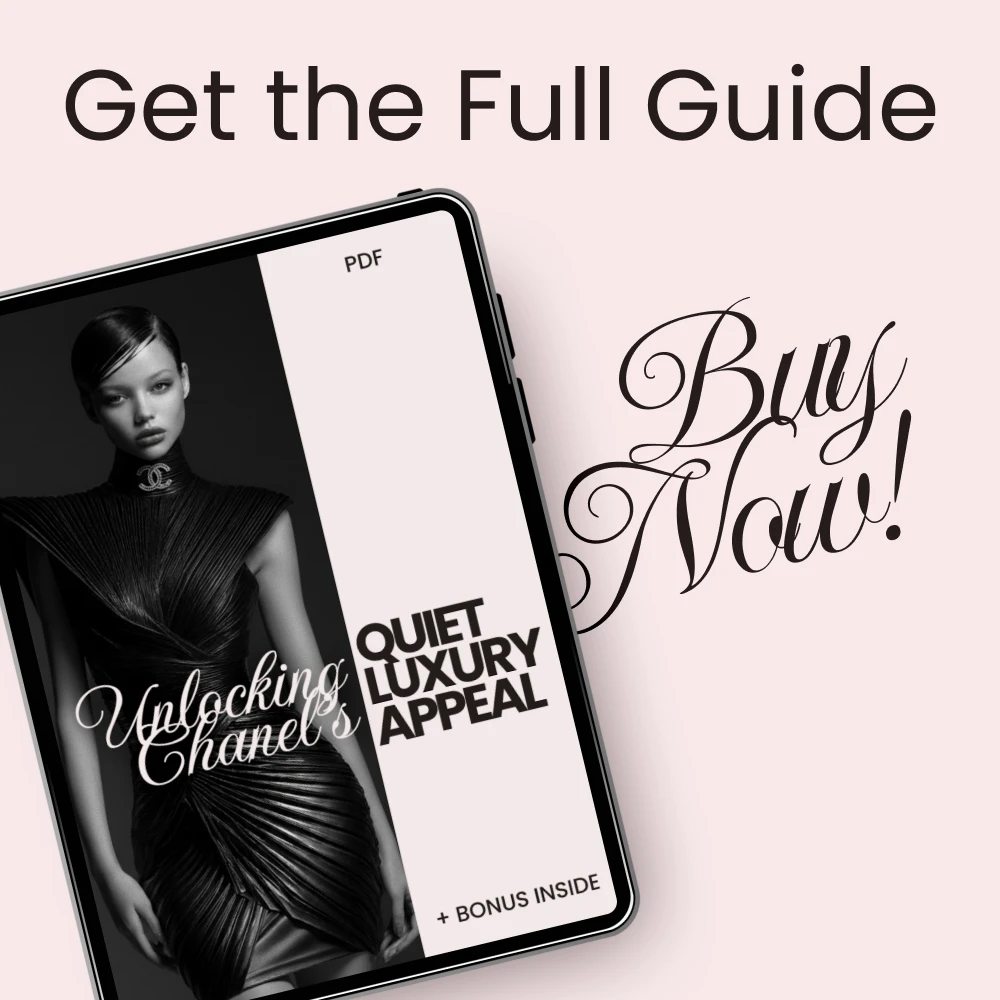
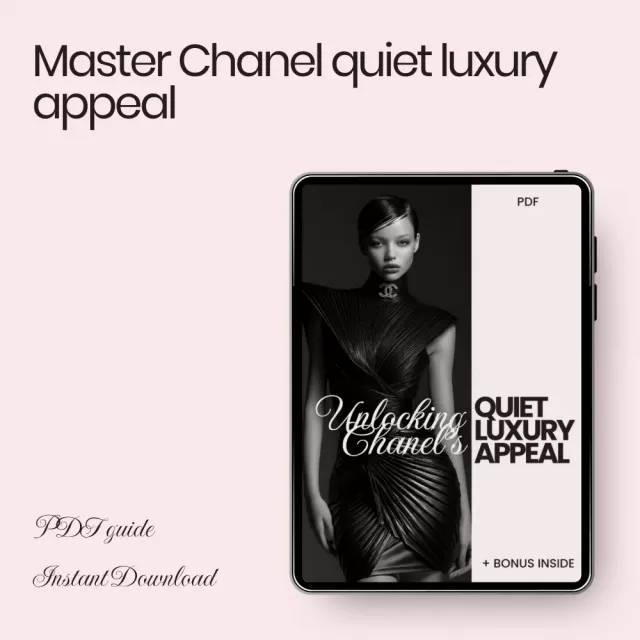
Discover the True Essence of Understated Elegance
What makes Chanel the ultimate symbol of refined sophistication? Unlocking Chanel’s Quiet Luxury Appeal is your insider guide to understanding and embodying the chanel quiet luxury appeal that fashion insiders admire and emulate. This thoughtfully crafted digital guide goes beyond trends and logos to reveal the philosophy, craftsmanship, and subtle power behind one of the world’s most iconic fashion houses.
If you’ve ever wanted to master the art of looking effortlessly polished without appearing flashy, this guide will show you how. Through practical insights, case studies, and modern AI-powered styling strategies, you’ll learn how to integrate timeless elegance into your wardrobe and lifestyle—without overspending.
What’s Inside This Digital Guide
- Chapter 1: Understanding Quiet Luxury – A clear breakdown of what quiet luxury really means, the philosophy behind Chanel’s understated elegance, and why less is truly more.
- Chapter 2: Chanel’s Signature Elements – A deep dive into timeless fabrics, impeccable craftsmanship, iconic jackets and bags, minimalist branding, and a detailed case study of how the Chanel 2.55 bag became a symbol of quiet luxury.
- Chapter 3: Integrating Quiet Luxury Into Your Wardrobe – Essential pieces to invest in, common mistakes to avoid, and AI-powered styling tips to personalize luxury on a realistic budget.
- Chapter 4: Beyond Fashion – The Lifestyle of Quiet Luxury – How to live the Chanel way through curated experiences, subtle social media presence, and actionable steps to build your own refined identity.
Who This Guide Is For
This guide is perfect for fashion enthusiasts, aspiring stylists, personal brand builders, content creators, and anyone drawn to elevated minimalism. Whether you’re refining your wardrobe, curating your social media, or redefining your personal style, this resource helps you align with the timeless principles behind the chanel quiet luxury appeal.
Why This Guide Is Different
- Combines fashion history, philosophy, and modern technology in one practical resource
- Includes AI-powered tools and styling insights rarely covered in traditional fashion eBooks
- Focuses on both wardrobe and lifestyle transformation
- Written in a clear, approachable tone without industry jargon
The Benefits You’ll Experience
- Build a refined wardrobe rooted in timeless elegance
- Make smarter investment purchases
- Avoid common styling mistakes that dilute sophistication
- Create a cohesive, subtle luxury identity online and offline
- Feel confident embracing quality over flash
Start Your Quiet Luxury Journey Today
If you’re ready to elevate your style with intention and confidence, Unlocking Chanel’s Quiet Luxury Appeal is your essential roadmap. Download your digital guide today and begin embodying the effortless sophistication that defines true quiet luxury.
Order cancellation
All orders can be cancelled until they are shipped. If your order has been paid and you need to make a change or cancel an order, you must contact us within 12 hours. Once the packaging and shipping process has started, it can no longer be cancelled.
Refunds
Your satisfaction is our #1 priority. Therefore, you can request a refund or reshipment for ordered products if:
- If you did not receive the product within the guaranteed time( 45 days not including 2-5 day processing) you can request a refund or a reshipment.
- If you received the wrong item you can request a refund or a reshipment.
- If you do not want the product you’ve received you may request a refund but you must return the item at your expense and the item must be unused.
We do not issue the refund if:
- Your order did not arrive due to factors within your control (i.e. providing the wrong shipping address)
- Your order did not arrive due to exceptional circumstances outside the control of legendarypicksmarket.shop (i.e. not cleared by customs, delayed by a natural disaster).
- Other exceptional circumstances outside the control of https://legendarypicksmarket.shop
*You can submit refund requests within 15 days after the guaranteed period for delivery (45 days) has expired. You can do it by sending a message on Contact Us page
If you are approved for a refund, then your refund will be processed, and a credit will automatically be applied to your credit card or original method of payment, within 14 days.
Exchanges
If for any reason you would like to exchange your product, perhaps for a different size in clothing. You must contact us first and we will guide you through the steps.
Please do not send your purchase back to us unless we authorise you to do so.
Instant download
Your purchase will be available to download once payment is confirmed.
Instant download items don’t accept returns, exchanges or cancellations. Please contact us if you have any problems








Finally a guide that explains the difference between true elegance and expensive noise. The breakdown of how Coco Chanel prioritized comfort and simplicity over status symbols reframed how I think about getting dressed. The section on mindful consumption alone was worth downloading this.
✨
I spent years buying whatever had the biggest logo thinking that was the point, until I came across this guide. The explanation of why subtlety signals refinement more than obvious branding completely shifted my approach to shopping. What really hit me was the case study on the Chanel 2.55 — learning how the Mademoiselle lock and chain strap were designed for function first made me rethink what I was actually paying for in any bag. I went back through my closet afterward and realized I had almost no neutral basics, no cashmere, nothing with real stitch quality worth noticing. Three months on, my wardrobe is smaller but I actually love everything in it The practical tip about focusing on fabric, fit, and detail before price or brand has become my personal shopping rule.
The Chanel 2.55 case study is the best brand breakdown I've read.
The section on common mistakes was a wake-up call — I had been pairing a high-end bag with fast fashion pieces and wondering why my outfits felt off. Learning that coherence matters more than one statement item changed everything ✨ Now I invest in fewer things and the whole look pulls together.
Bouclé tweeds and silk satins explained as texture choices, not trend choices — finally
The philosophy sections are beautiful and the lifestyle chapter — particularly experiences over logos — really resonated with me. I would have loved more specific shopping guidance beyond cashmere sweaters and tailored trousers, but what's here is thoughtful and well-framed. Solid read for anyone trying to build a wardrobe with actual intention.
The tip about keeping a quiet luxury journal is something I actually started doing.
What I appreciated most was how the guide distinguishes between communicating refinement versus communicating wealth — those aren't the same thing, and it's rarely explained so clearly. The AI styling prompts were a nice practical touch, especially the one about building outfits around neutral sweaters and leather accessories. Made me want to audit my wardrobe immediately.
Ignoring details like stitching and button quality — I was absolutely guilty of this.
I'll be honest — I downloaded this mostly because my partner kept talking about quiet luxury and I had no real context for what it actually meant. Expecting something surface-level, I ended up reading the whole thing in one sitting. The explanation of how the Chanel 2.55 launched in February 1955 with function built into every element — the chain, the pockets, the lock — gave me a framework I hadn't had before. I also appreciated the point that logos being limited to hardware or lining is a deliberate choice, not an oversight. My one mild note is that the social media curation section felt a bit brief compared to the depth of the wardrobe chapters. Still, this reshaped how I think about quality versus price, which I didn't expect from something this compact.
Every wardrobe edit I've done since reading this has been quieter, cleaner, better.
The point about chasing trends diluting timeless appeal landed hard. I've bought so many things over the last two years because they were 'the moment' and almost none of them still feel relevant. The focus on cashmere, silk, and premium leather as a foundation rather than a luxury add-on reordered my priorities. Reading about Coco Chanel's original ethos of comfort and freedom of movement made the whole thing feel historically grounded, not just trend-adjacent.
️✨️
I used to walk into rooms wearing head-to-toe logos feeling like I was dressed well, but I never felt polished — just expensive. A friend mentioned the concept of quiet luxury and I finally looked into it properly through this guide. The opening chapter reframed everything: sophistication that whispers rather than shouts. That one line alone was enough to change how I looked at my wardrobe. I read through the section on Chanel's signature elements and realized I owned almost nothing with real fabric quality — my leathers were synthetic, my 'silk' blouses were polyester, and I'd never once considered whether a button said anything about craftsmanship. The case study on the 2.55 bag was the most instructive part for me. Understanding that the quilted exterior, the Mademoiselle lock, and the chain strap were all rooted in elegance-meets-function helped me understand what I should be looking for in anything I buy, not just bags. After finishing this, I spent about a month slowly replacing fast pieces with fewer, better ones — a well-fitted wool coat, two cashmere sweaters, one structured leather bag with real hardware. Getting dressed now feels calm in a way it never did before.
The lifestyle chapter's point about investing in experiences over logos reframed luxury as something you live, not just something you wear. I particularly liked how it connects mindful consumption across categories — furniture, jewelry, books — not just clothing. This doesn't read like a fashion guide, it reads like a philosophy ✨
Pearl accessories as quiet luxury icons — obvious in retrospect, genuinely eye-opening to read.
Well-written and useful, though the AI tips section felt slightly out of place.
The framing of quiet luxury as a visual language you learn to read rather than a price point you reach is what makes this guide stand out. Once I understood that recognition comes from those with a real eye for detail — not everyone in the room — the pressure to show off lifted completely. The practical tip about sticking to wool, cashmere, silk, and premium leather as a fabric filter has already saved me from several bad purchases.
Neutral tones, tailored fit, subtle hardware — it really is that simple.
I work in a creative field where the pressure to look current is constant, and I was exhausted by it. A colleague who always looked effortlessly put-together mentioned she lived by timelessness over trends, which led me here. The section on common mistakes was the most useful thing I read — over-branding, neglecting fit, ignoring detail. I'd been doing all three without realizing it. What helped most was the coherence point: it's not about owning one expensive piece but about quality across everything in the look. I rebuilt my approach to getting dressed from that idea, and six months later my wardrobe is half the size and I get more compliments than ever.
The note about logos appearing only on hardware or lining — not fabric surfaces — as a deliberate design philosophy shifted how I evaluate pieces I've started turning bags inside out in stores to check lining quality. The 2.55 bag case study gave me a whole new appreciation for the chain strap as design history, not just a style choice.
Buying less but better — not just a wardrobe tip, a whole life shift.
The sections on Chanel's design philosophy and the 2.55 bag are genuinely well-researched and engaging — I learned things I hadn't known despite following fashion for years. The lifestyle chapter on experiences over logos also landed well. My hesitation is that the second half feels more introductory than the first half promised, and some of the AI tips read as speculative rather than tested. Worth reading, but I wanted more depth.
The Mademoiselle lock detail in the 2.55 story genuinely stopped me mid-read.
I've read a lot of fashion content that throws around the word 'timeless' without ever defining it, but this guide actually does the work. The distinction between timelessness over trends and quality over quantity as separate principles — not the same idea — made the whole philosophy feel much more actionable. The color palette section, especially the note on bouclé tweeds and silk satins creating depth without ornamentation, helped me finally understand why certain outfits feel luxurious even when they're quiet.
Restraint as a style choice rather than a budget limitation — that reframe was everything.
Thoughtful and cohesive — the connection drawn between Coco Chanel's original philosophy and what the guide calls a quiet rebellion against conspicuous consumption made the whole thing feel more substantive than a typical style read. I would have appreciated more depth on evaluating quality in specific materials, particularly leather, beyond the high-level advice. Still a strong piece of work overall.
A close friend dragged me to a Chanel exhibit a couple of years ago, and I spent the whole time wondering why any of it mattered. Then I found this guide while researching whether a particular jacket was worth the price, and suddenly the exhibit made sense retroactively. Understanding that each stitch and seam in the Chanel jacket is intentional — that it's an art form, not just tailoring — recontextualized what I'd seen. The section on tailored outerwear elevating any outfit helped me finally justify a purchase I'd been hesitating on for months. What I most took away was that the guide never makes quiet luxury feel exclusive or gatekept — it consistently frames it as a way of thinking, not a price bracket. The practical wardrobe section is the most reusable part; I return to it whenever I'm deciding whether something belongs in my closet.
✨
The coherence principle changed how I evaluate every purchase, not just fashion ones.
Starting with the definition — sophistication that whispers rather than shouts — and building outward from there is exactly the right structure for this kind of guide. The section on how Chanel uses neutral tones and soft pastels alongside texture rather than pattern to create depth was something I'd observed in clothing but never articulated. Now I can actually explain why certain outfits feel more elevated than others, which has changed how I shop and how I dress.
The wardrobe integration chapter is practical in a way most style guides aren't — the cashmere, silk, tailored trousers framework is actually usable as a shopping checklist. My one critique is that the guide occasionally states the obvious for anyone already familiar with Coco Chanel's history. For someone coming in fresh, though, it's perfectly pitched. The reminder that neglecting fit is the most common quiet luxury mistake felt particularly honest.
I want to be precise about what this guide did for me because vague praise doesn't do it justice. I came to it after a period where I'd spent more money than I care to admit on clothing and still felt like nothing in my wardrobe worked together. I'd been buying individual statement pieces — a logo bag here, a trendy coat there — without any coherent thread connecting them. The guide's point about coherence being more important than a single expensive item described my situation exactly. Working through the common mistakes section felt uncomfortably accurate: over-branding, chasing trends, neglecting fit, ignoring detail — four out of four. The key pieces section — tailored outerwear, cashmere neutrals, structured bags without visible logos, refined accessories — gave me vocabulary for what I actually wanted, which I'd never had before. The idea that a curated wardrobe amplifies the quiet luxury effect rather than diluting it through volume shifted how I thought about editing down. The lifestyle chapter was unexpected and welcome — the point about fine dining, art exhibitions, and cultural experiences communicating sophistication more effectively than logos was something I'd felt but never heard framed that way. The quiet luxury journal tip sounds minor but turned out to be genuinely useful; I've been keeping one for two months and it's helped me identify patterns in what I actually wear versus what I buy. I've spent less and felt better dressed since reading this than at any point in the previous three years.
Silk blouses, tailored trousers in muted tones — I had the pieces, just needed the framework.
The point about pearl earrings as logo-free luxury is something I'll be repeating constantly.
There's real substance here — the breakdown of how Chanel keeps logos limited to hardware and lining as an intentional philosophy rather than an afterthought is genuinely insightful. The section on confidence in restraint also offered a perspective I hadn't considered before. That said, the guide covers a lot of ground quickly and some sections felt more introductory than the title suggested — I was hoping for deeper analysis of specific pieces and materials. Worth the time, just set expectations accordingly.
What makes this guide stick is that it treats quiet luxury as something you internalize rather than something you perform. The Chanel 2.55 origin story — launched in February 1955 with function driving every design choice — is the best possible illustration of that principle. When you understand that the chain strap existed so a woman could keep her hands free, the whole aesthetic philosophy clicks into place. I also found the point about investing in fewer, higher-quality pieces that coordinate easily more useful than I expected Most style advice talks about building a wardrobe without explaining the underlying logic — connecting restraint to the idea that a small curated collection amplifies the quiet luxury effect reframed it as a creative act. This is one of those reads I'll return to whenever my wardrobe starts drifting toward noise.